

Short non-fiction by Sanders Isaac Bernstein and Marcel Krueger
‘Daily Maintenance’ and ‘Many People in Our Country are Very Concerned About This’


These two short essays were read by their authors at a recent celebration of Christa Wolf (1929–2011) at Lettrétage in Berlin.
Daily Maintenance
Sanders Isaac Bernstein
October 30, 2025
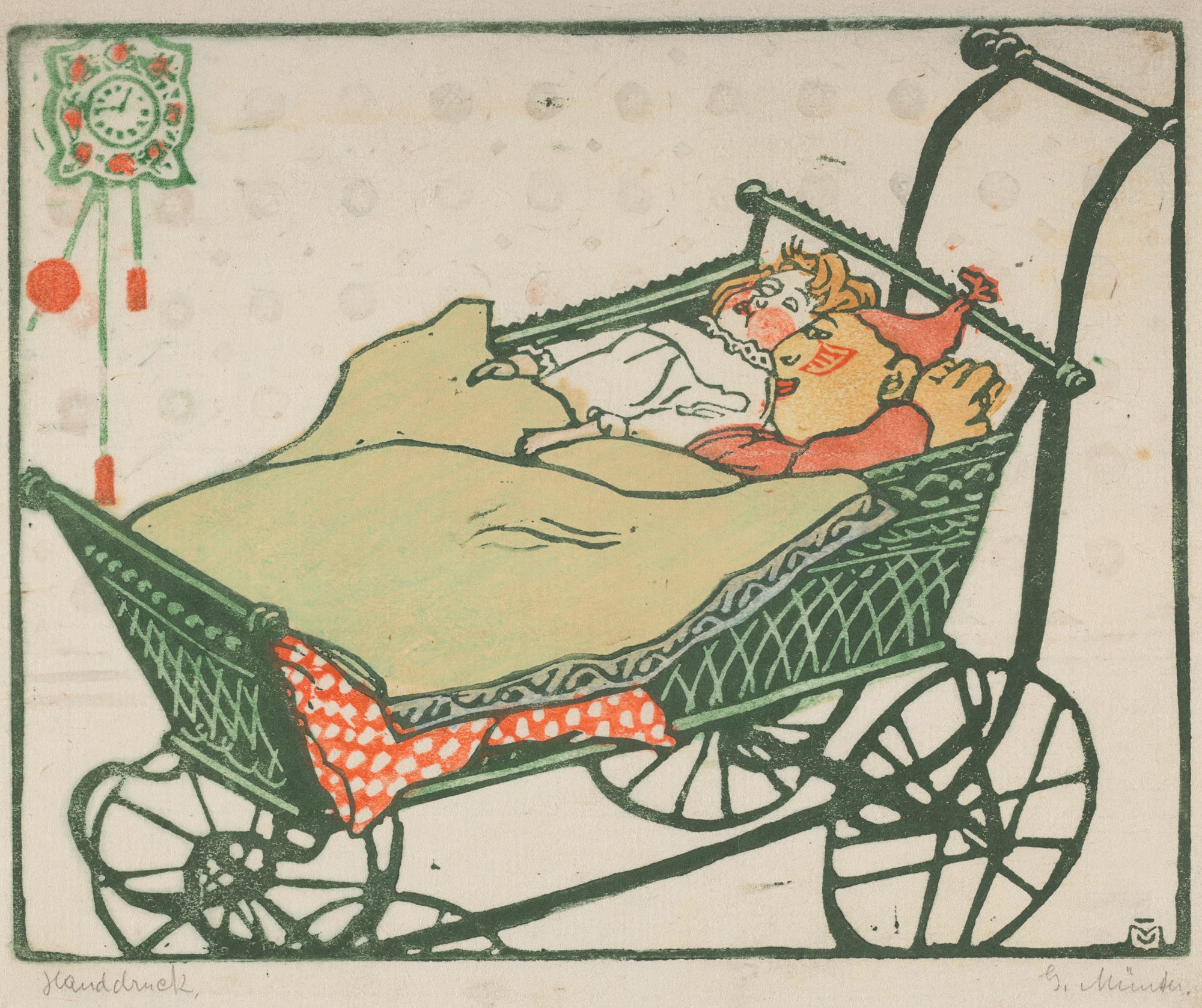
I lay you down on your changing table, sly smile on your impossibly cheeky face as I pull off your trousers and unbutton the snaps of your onesie. Do you already know what you are about to do, you duplicitous ferret? It’s so easy to impute to your steady gaze and general refusal of words a kind of impudent omniscience, that your innocence is feigned, that you know that by pretending to absolute helplessness, you achieve absolute control. I lift your hips and begin to gently wipe you clean of your refuse. Some father figure of artificial intelligence declared that the technology will soon rule us all, because, he said, the only creature on God’s green earth controlled by a less intelligent one was a mother by her baby—and, for that, evolution had to put the work in. Your existence has become the metronome for ours, the day’s heartbeat, if we still knew what a day was. Even as we have counted the days since your birth—they number one hundred and four—you have turned the day as a unit of experience increasingly meaningless. In university, I learned how the medieval Christians conceived of God seeing time spatially, everything in a simultaneity, as, knowing all that was going to happen, time did not unfold. Future, past, present, all were fixed as if on an enormous canvas. I remember too the attempted rationalizations of the creation of the world in seven days from Hebrew School. There are many kinds of days, we were told. The Earth’s day is only one kind. The lunar day is almost a month. And the cosmic day lasts for about 40 million of our years. What, then, might be a day for God, they asked—and who were we to say how long those six days of creation really were? You press your thick little stomach against my hand as I slide your night’s diaper out from under you, its purpose fulfilled, and place it in its depository. What is a day for you, you vessel of intensities? You know no concepts, no time, no tragedy. I turn to find a new diaper, somewhere behind me, as you gurgle happily—life’s a comedy—my hand remaining on your stomach to steady you atop the washing machine. How many times have I done this since you were born, in this day, which goes on seemingly unbroken by night’s slumber? You certainly sleep, enough for the both of us, but you sleep when the sun is out—and when we sleep, in the night, you wake us with all the force of your young lungs. Is it all a spirit of mischievousness, or should we fear that this is a sign of some early trauma, already some errant turn in your development? What do we know. After all, I am fumbling with the diaper in its packaging just as I sometimes fumble for words. My thoughts are always far more elegant in my head than on the page. Perhaps that is why I have not written in my diary for months, though I did write that line today. I could blame your arrival, my little son, for the lack of time, but even before your birth this year’s ledger stood largely empty. Time was already pressing upon me in a new way, and, under its weight, I could not seem to lift my head up for reflection. Perhaps my sense of days was already beginning to deteriorate then, your first shadowy presence dislocating the timescale of my existence. Instead of unfolding before me, my life finds itself leading into yours, a prehistory, a prologue, even the leader of the film whose full reel I will, hopefully, never see. With my hand on your wriggling, squidgy stomach (and the other still deep among the diapers), it’s hard to believe that you once did not exist, that there was ever a life before this, that this great warmth that chills with its intensity did not always bloom across my breast. I can almost even feel the warmth right now, warmly electric and coldly, anxiously pulsating, there it is at my elbow, almost a pulsating current. But quickly, this warmth turns damper, colder. You let out a triumphant screech, you dinosaur with a sore throat. You’ve peed on me again. And what do you do? You lie on your naked back, warm and dry, your sly smile widening. And, like so many times before and to come in this long day of your existence, you laugh at your father.
Many People in Our Country are Very Concerned About This
Marcel Krueger
Pick any day in the long account of calamities that was the German 20th century, and it will be one that, for some, was one of horror and ruin.
On September 17th, 1991, in Hoyerswerda in Saxony, a racist mob attacked a hostel for workers from Mozambique and Vietnam with Molotov cocktails and bricks.
On September 19th, 1991, in an arson attack on an asylum seekers hostel in Saarlouis, Samuel Kofi Yeboah from Ghana was burnt to death.
October 3rd, 1991, was the new Day of German Unity, just announced the year before, and in his address to the nation chancellor Helmut Kohl stated that:
‘Germany is a country that welcomes foreigners—and will remain so. However, this does not mean that we can stand idly by and watch the abuse of asylum law. I know that many people in our country are very concerned about this. Our constitutional state must take decisive action as a matter of urgency, and I will do everything in my power to ensure that the abuse of the right to asylum is stopped as quickly as possible.’
On the same day, in Hünxe in North Rhine-Westphalia, four Lebanese refugee children were injured in arson attacks. In Brühl in Baden-Württemberg, skinheads attacked a group of Nigerians at a funfair. In Gotha in Thuringia, four off-duty Soviet soldiers were thrown out of an apartment window by another group of skinheads.
On March 15th, 1992, in a neo-Nazi attack in Saal in Mecklenburg-Vorpommern, 18-year old Romanian asylum seeker Dragomir Christinel was beaten to death.
On May 28th, 1992, a centre for asylum seekers was attacked by several hundred residents in Mannheim-Schönau.
Starting August 22nd, 1992, several hundred rioters attacked the central reception centre for asylum seekers and a hostel for Vietnamese contract workers in Rostock-Lichtenhagen. Over 3,000 spectators protected the attackers and hindered the deployment of the police and fire brigades.
On October 11th, 1992, waitress Waltraud Scheffler was mortally injured in a neo-Nazi attack on a pub in Geierswalde in Saxony.
On the 23rd of November, 1992, neo-Nazis threw Molotov cocktails at the house of a Turkish family in Mölln in North-Rhine Westphalia, and murdered Bahide Arslan (51) and her granddaughters Yeliz Arslan (10) and Ayşe Yılmaz (14).
On the 19th of February, 1993, 22-year-old Mike Zerna was killed by neo-Nazis in a youth club in Hoyerswerda.
On May 26th, 1993, the German parliament, the Bundestag, voted on the so-called ‘asylum compromise’, an amendment to the constitution: no one who had previously stayed in a ‘safe third country’ would be able to claim asylum in Germany going forward. 521 members of the Bundestag voted in favour, 132 against.
One of my own days of ruin was just two days after. On May 28th, 1993, four neo-Nazis set fire to the house of a Turkish family in my hometown of Solingen, and murdered Gürsün İnce (27), Hatice Genç (18), Gülistan Öztürk (12), Hülya Genç (9), and Saime Genç (4).
It was a hot day in May, an early onset of summer, and from the TV room in the attic I followed the news about the attack and the subsequent riots when the Turkish community vented their pain and anger in loud protest and smashed shop windows across town. I walked past glaziers repairing those windows two days later on my way to the burned-out shell of the house, where I stood with many others looking at it in shock, its blackened and empty windows looking down on us like an accusation.
Two months later, the house was torn down. An empty plot with a small memorial plaque remains today at Untere Wernerstrasse. On the fenced-off, grass-covered plot, five chestnut trees were planted to remember the victims. Yet the official memorial to the Solingen attack is an unofficial one. It was created in 1994 by teacher Heinz Siering and artist Sabine Mertens together with students of Mildred Scheel Vocational College, and still stands on the school grounds: two metal figures pulling a swastika apart. It is an unfinished memorial, after a fashion. Its foundation is constantly growing as the public can donate metal rings that are integrated into the base to this day. One such ring carries my name.
What is past is not dead; it is not even past, and few things ever change in Germany.
On March 25th, 2024, an arson attack against the house of a Turkish-Bulgarian family in Solingen killed Kancho Emilov Zhilov (30), Katya Todorova Zhilova (29), Galia Kancheva Zhilova (2) and Emily Kancheva Zhilova (4 months). The perpetrator Daniel S., who was cleared of all suspicions of right-wing extremism by the public prosecutor just weeks after his arrest, had the ‘Lied eines Asylsuchenden’, a hateful ‘Song of an Asylum Seeker’ poem that first became popular with right-wing extremists in 1992, pinned to the walls of his garage.
At 20:30 on June 6, Immer Schon returns to Lettrétage with ‘Sebald Remembering’, an homage to W.G. Sebald featuring Marcel Krueger, Madeleine Watts, and Paul Scraton.
Selected readers will also be invited to share their work at the event and will have their work published online and in a printed zine commemorating the evening. You can email your submission of 600-800 words (or up to 30 lines of poetry) to JosephRothToday@gmail.com by May 17. For more information, visit their website.
 | A guest post by
|