

Oi quick question! What's a great opening?
For an extra scoop of Auflauf, we asked some mates how best to begin.

For this semi-regular feature, we will be texting our local colleagues, friends, and crushes to ask them a question real quick and then publishing the answers. Call this a round of short solos from the big band, or some sort of literary Meinungsforschung. To celebrate The Auflauf’s first month, we asked people (and each other) to nominate an all-time literary opening: be it for story, book, or poem.
Vijay Khurana (novelist and translator)
A good story opening: something riptidal, a sentence into a blind corner, a voice that demands a hearing. Donald Barthelme: I know you think I’m wasting my time. You’ve made that perfectly clear. But I’m conducting these very important lunar hostility studies.
Patrik Gräb (writer and cultural programmer)
Yesterday I flipped through Stefan Zweig’s Die Welt von Gestern, which my mother had taken from our bookshelf during a recent visit and left lying face down on the guest bed. I ended up reading a passage in which Zweig witnesses Emperor Karl I. leaving on a train after the dissolution of the Austro-Hungarian monarchy in 1918.
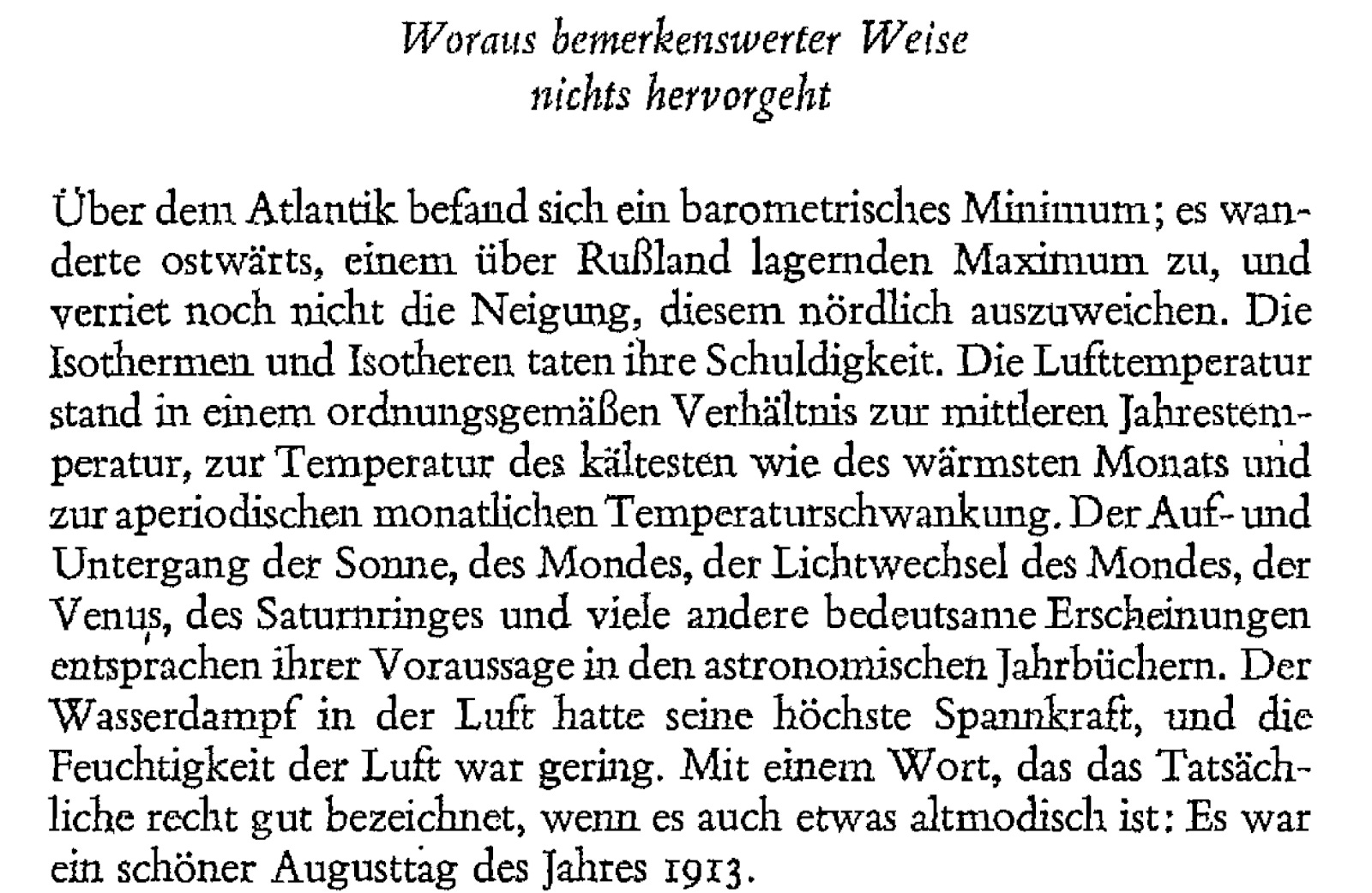
Zweig’s memoir deals with the shock of one epoch ending, the absolute break with the past that was brought about by the Great War in 1914. So does my favourite book of all time: Robert Musil’s Man without Qualities – but it does so in a very different way. The famous opening is striking for its tone, evoking both the overwhelming scale of the cosmos and the banal predictabiliy of its laws. Musil’s composition seems to almost deny the book’s importance: in this grandest scheme of things, what is even a World War? The very Musilian tragic irony of starting the novel talking about the weather, about a beautiful day in August 1913, points to what makes this book so great: Musil is writing about the Vienna before 1914 not as belonging to a world of yesterday, but one that is entirely part of an exciting, chaotic, funny, stupid and unstoppable continuum leading to the catastrophic present that is his vantage point.
Tessa Sinclair Scott (poet)
1. Saga by Hannah Mettner
Saga
In the tradition of my people, I come to you
with a long and winding story that neither
starts at the beginning nor finishes at the end.
There is, however, a lot of middle, which is
the way with all the best sandwiches. I mean
sagas.
2. Drive Your Plow Over the Bones of the Dead by Olga Tokarczuk, (trans. Antonia Lloyd-Jones)
“I am already at an age and additionally in a state where I must always wash my feet thoroughly before bed, in the event of having to be removed by an ambulance in the Night.”
There’s nothing really to add.
Mathilde Montpetit (Auflauf)
“At beauty I have gazed so much / that my vision is filled with it” (Cavafy, trans. Daniel Mendelsohn).
Rebecca Rukeyser (novelist)
Who Was Changed and Who Was Dead by Barbara Comyns! The whole first part describes the aftermath of a flood in terms of an inventory of farm animals—ducks (happily swimming) pig (swimming in panic) hens (committed suicide because they were “depressed and hungry”) sitting hens (”they sat on their eggs in a black broody dream until they were covered in water.”) Subsequently, the entire village goes mad. She’s a genius. “It’s a bad thing for the sun to shine on a flood, it draws the dampness back to the sky.”


Alexander Wells (Auflauf)
The first lines of the first poem of Jorie Graham’s Sea Change, the first collection I ever fell in love with:
“One day: stronger wind than anyone expected. Stronger than
                                                             ever before in the recording
                                                             of such. Un-
natural says the news. Also the body says it. Which part of the body—I look
                                                            down, can
                                                            feel it, yes, don’t know…”
Alexander Lin (scholar)
The last chapter of the Decline and Fall opens with Gibbon elegantly paraphrasing the “melancholy picture” of the End of History glimpsed by Poggio Bracciolini from a deserted Capitoline Hill in early 15th century Rome; but I’d like to draw your attention to the footnote to this first sentence, where the English historian supplies the original Latin text of De varietate fortunae (On the Vicissitudes of Fortune):
“Consedimus in ipsis Tarpeiæ arcis ruinis, pone ingens portæ cuiusdam, ut puto, templi, marmoreum limen, plurimasque passim confractas columnas, unde magnâ ex parte prospectus urbis patet.” ([I’ll give it a try:] We sat among the ruins of the Tarpeian Arx, behind the enormous marble lintel of the gate of what I took to be some temple and everywhere endless crushed columns, whence the prospect of the greater part of the city opened.)
We perceive in this excerpt Gibbon’s “native capacity for choosing what is picturesque,” as Arnaldo Momigliano put it; his appropriation of the Florentine humanist’s act of hunkering down and gazing out to claim his own spot on the rock; and even the moment when he first caught sight of the ruinous prospect and arduous project to be written. (Poggio himself had made the effort of the climb up the Capitol in order to look through Virgil’s eyes and “invert his verse” (Ut quidem is uersus merito possit conuerti) on the founding, into the rotting, of Empire.) The last line of the labor of nearly two decades ends with the timestamp “Lausanne/ June 27, 1787” but glimpses the light, and hears the echoes, of its own beginnings: “In my Journal the place and moment of conception are recorded; the fifteenth of October 1764, in the close of evening, as I sat musing in the Church of the Zoccolanti or Franciscan friars, while they were singing Vespers in the Temple of Jupiter on the ruins of the Capitol” (from the Memoirs). Twenty years’ toil it may take to ascertain the precise time and place that will have motivated and justified all the work ahead, as though it were a battle worthy of the annals; but this moment, in all its awestruck sighing (suspirans stupentique similis) and semblance of effortless citation, would soon fade and peel off the wall, if it were not already under-painted and varnished with world-inverting nostalgia.
Sanders Isaac Bernstein (Auflauf)
“He came after Homer and before Gertrude Stein, a difficult interval for a poet” – Autobiography of Red by Anne Carson
Errata
The recent release of certain emails has alerted the Editors that a number of statements in a report written by a freelance gossip reporter for The Auflauf are, or may be, false. The Editors apologize for these errors and assure our readers that we have cut ties with the reporter in question.