

May Books: Barton, Koeppen, Celan
An expat novel by Polly Barton, two thirds of Wolfgang Koeppen's postwar trilogy, prose ephemera from Paul Celan, and an apology


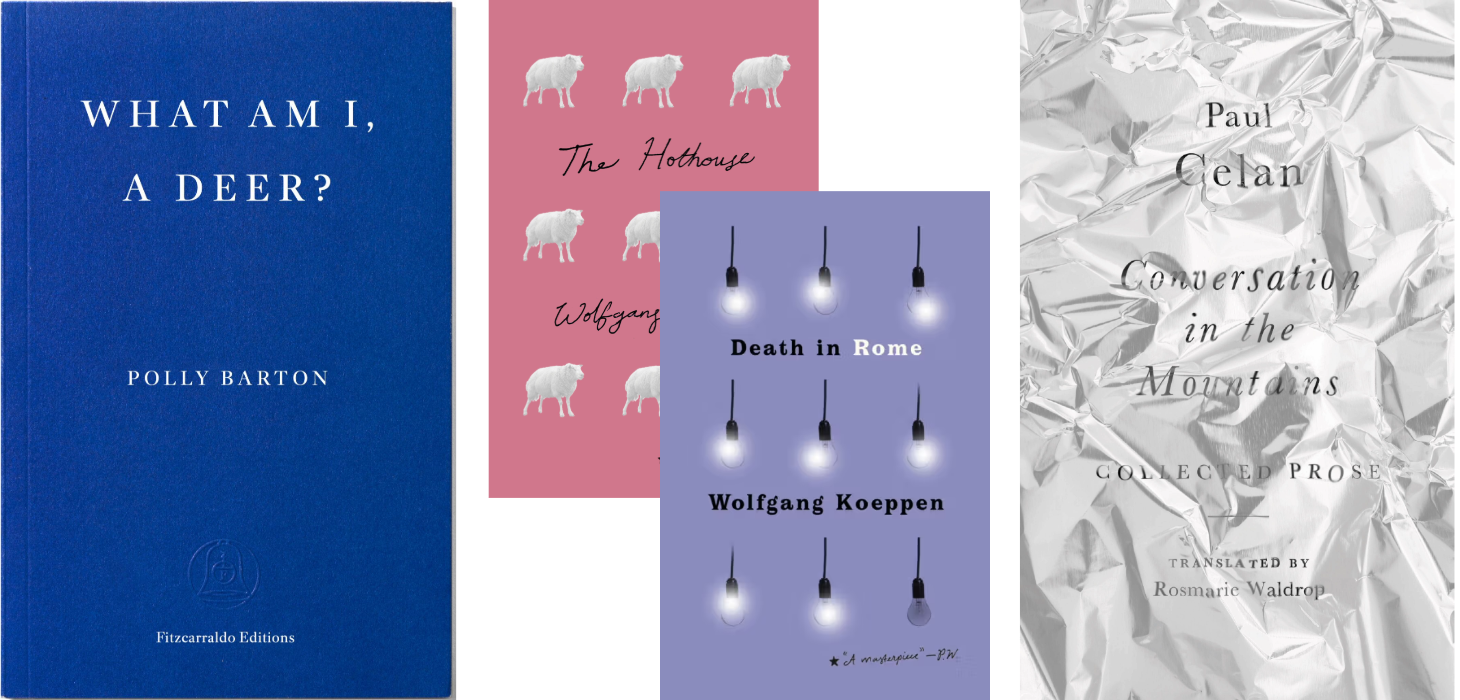
What Am I, A Deer? (Fitzcarraldo)
Polly Barton
In case you haven’t heard, Isabella Rossellini has been doing great stuff on Youtube. In the ‘Seduce Me’ miniseries, the actress, in outfits and sets constructed with the enthusiasm and sensibility of a primary school art project, reenacts and explains the mating rituals of various animals. One opens with a hand stroking a large kitchen knife against her face. ‘Is he seducing me?’ she asks the camera. ‘What am I, a BEDBUG?’
The unnamed narrator of Polly Barton’s debut novel nervously IMs this video to a colleague one afternoon. She’s the odd man out at the company she’s recently joined, a winkingly-unnamed Japanese video game behemoth based in Frankfurt. Her colleagues are, well, proper nerds: Brits who like video games and anime and more video games. She likes Japan too, but not like that. Sending the video is a bid for connection. It works—they all start saying ’What am I, a WEEB?’ to each other—but only briefly.
Does she want to let these people in, or does she want to keep them out? And does she want to be seduced? The narrator spends much of the novel consumed by an earth-shattering crush on a colleague she refuses to speak to, while continually standing aloof from the affections of another. She likes Frankfurt in part because it doesn’t demand her to really engage. Walking down the street, she muses that ‘In London she had walked down the streets and felt waves of longing to be with people on the inside of the glass, where she was wanted and integral, but here, she felt herself included simply by passing by.’
But the real interstitial zone, the one place where this contradiction can be apotheosized, is the karaoke booth. Barton has previously published nonfiction (in addition to translations from Japanese), and there’s something of informative direct address here too. The book is at its best in its lengthy disquisitions on the ecstasies of Japanese-style karaoke. Both translating and karaoke, the narrator muses, are ways of ‘inhabiting something fully without committing to that thing, living in the luxurious promise and possibility of it and not the isolated, consequence-laden reality.’ In the karaoke booth you can try things on: feel karaoke emotions and cry karaoke tears, never having to admit real desire, real wanting, real need.
In the end, the worst thing to be is a deer, the pick-me girl of the animal kingdom. When she does act on her desires, Fiona Apple’s ‘I Want You to Love Me’ is the humiliating soundtrack to her disappointment: ‘And while I’m in this body / I want somebody to want / And I want what I want / And I want / you to love me.’ – MM
Death in Rome and The Hothouse (New Directions)
Wolfgang Koeppen, trans. Michael Hofmann
Wolfgang Koeppen’s Death in Rome opens like a fairytale—‘Es war einmal eine Zeit…’—and closes with a grotesque comic riff on the closing line of Thomas Mann’s Death in Venice. In between are roughly 180 pages of savage satire in which Koeppen, axe in hand, hacks away at the delusional amnesia of postwar West Germany. It’s deservedly being hailed as a rediscovered masterpiece, now reissued by New Directions alongside another novel from Koeppen’s trilogy of postwar novels, The Hothouse (the first, Pigeon in Grass, a kaleidoscopic 1951 account of a single day in Munich, was released in translation in 2020).
The set-up is a deranged makeshift family reunion in postwar Rome, the relatives repeatedly crossing paths over a frantic two days. Friedrich Wilhelm Pfaffrath, ex-Nazi bureaucrat, has arranged a secret rendezvous with his crazed genocidal brother-in-law, Gottlieb Judejahn, a former high-ranking SS officer who escaped capture and is now a mercenary in the employ of an unnamed Arab country. Pfaffrath hopes to contrive Judejahn’s return to West Germany: surely a few thousand murders can now be forgotten.
By chance, their estranged sons are also in Rome: Siegfried Pfaffrath, an avant garde composer debuting his symphony, and Adolf Judejahn, a Catholic convert preparing for the priesthood. As in Mann, the characters are at least as much symbol as person. Translator Hofmann suggests in his introduction that the four represent the great strands of supposed German achievement—art, theology, bureaucracy and warfare—and that may well be right. But Hofmann leaves out the third son, Dietrich Pfaffrath, whose craven and vacuous opportunism might just stand in for the spirit of the Federal Republic in the Wirtschaftwunder years.
If that sounds plodding, rest assured it’s not: Death in Rome is a wildly energetic novel, the characters skittering across the page like dancers in a discordant bizarre ballet (for once an excellent match for Hofmann’s often heavy-handed translation style). There’s also a savage humor in Koeppen’s work that recalls Thomas Bernhard—both writers launched furious assaults, unrelenting and yet deviously entertaining, on the respectable facades their countries (West Germany, Austria) erected to conceal the horrors of the past.
The Hothouse, too, is a tight acrid satire on the hypocrisies of postwar West Germany that follows a disillusioned socialist MP as he unspools over a day in the haphazard capital of Bonn. Intriguing, but the tapestry of references and allusions feel more dated and obscure. It’s hard to compete with the hideous and extravagant fascist burlesque of Death in Rome, which fits unsettlingly well the mood of our own low dishonest decade. – Bryn Stole
Conversation in the Mountains: Collected Prose (New Directions)
Paul Celan, trans. Rosmarie Waldrop
This slim collection of the prose of the great poet Paul Celan is, by its nature, a minor work. Composed for the most part of occasional writing—speeches, replies to questionnaires, introductory biographical paragraphs about other poets—the book is a reissue of Rosemarie Waldrop’s excellent 1986 translation first commissioned by the UK’s Carcanet Press. Now being flogged by New Directions at 20 cents a page, it is basically a pamphlet. It could slip through the crack at the back of a bookshelf and disappear as if it never was—which might have been what happened to my review copy. At least, I can no longer find it.
Yet, however incidental these writings might be, the somber and brilliant mystery of Celan still breaks out from them. ‘So strong was his love for her it would have pushed open the lid of his coffin,’ goes one representative line in ‘Backlight’, ‘had the flower she placed there not been so heavy.’ And the gnomic titular essay presents a conversation between two Jews in the mountains, both of whom confront ‘a moveable veil’ into which images enter and begin a process whereby spinning thread ‘begets a child, half image, half veil’.
Within Celan’s notoriously obscure oeuvre, such a tangle counts as the major European poet—born in Romania in 1920, survivor of the Holocaust, and drowned in the Seine in 1970—engaging his Jewishness rather more directly than usual. And the book also offers a glimpse of Celan’s relationship to the German writer Georg Buchner. In ‘Conversation,’ Celan’s Jews are described as coming ‘like Lenz through the mountains’—likening the Jew to Buchner’s famous crisis-riddled protagonist—and in ‘The Meridian’, his speech given on receiving the Georg Buchner Prize, he puzzles over moments in the dramatist’s oeuvre that spoke to him. Even a three-paragraph reply to a questionnaire from Paris’ Flinker Bookstore on bilingual poetry—refusing its possibility—grants us his sense of poetry as ‘by necessity a unique instance of language’.
I might wish they were part of some larger collected volume of prose and poetry, but the writings this slender book offers are, like Celan’s poetry, elliptical and resistant to immediate understanding. Indeed, they also are his thought launched into the world, ‘thrown out to sea with the—sure not always strong—hope that it may somehow wash up somewhere, perhaps on a shoreline of the heart.’ Perhaps that’s where my copy has ended up. Some traces of its words, at least, remain on mine. – SIB
Hot Sauce
ERRATA: The Editors have learned that our former gossip correspondent Marguerite McEnnedy severely misrepresented the nature of her connection to the Limerick Writers’ Centre, and indeed the very mission of that Centre. We would like to offer our sincerest apologies to the Centre and the people of Limerick, and to ensure them and our readers that we have cut ties with the reporter in question.
We are now looking for a pan-European gossip correspondent who truly embodies our commitment to truth. Please send a CV, with cover letter, to theauflauf@substack.com.