

March Books: McDonald, Franck, Ismaïl
Poems by Matthew McDonald and novels from Julia Franck and Agri Ismaïl, plus some gossip from our new correspondent.


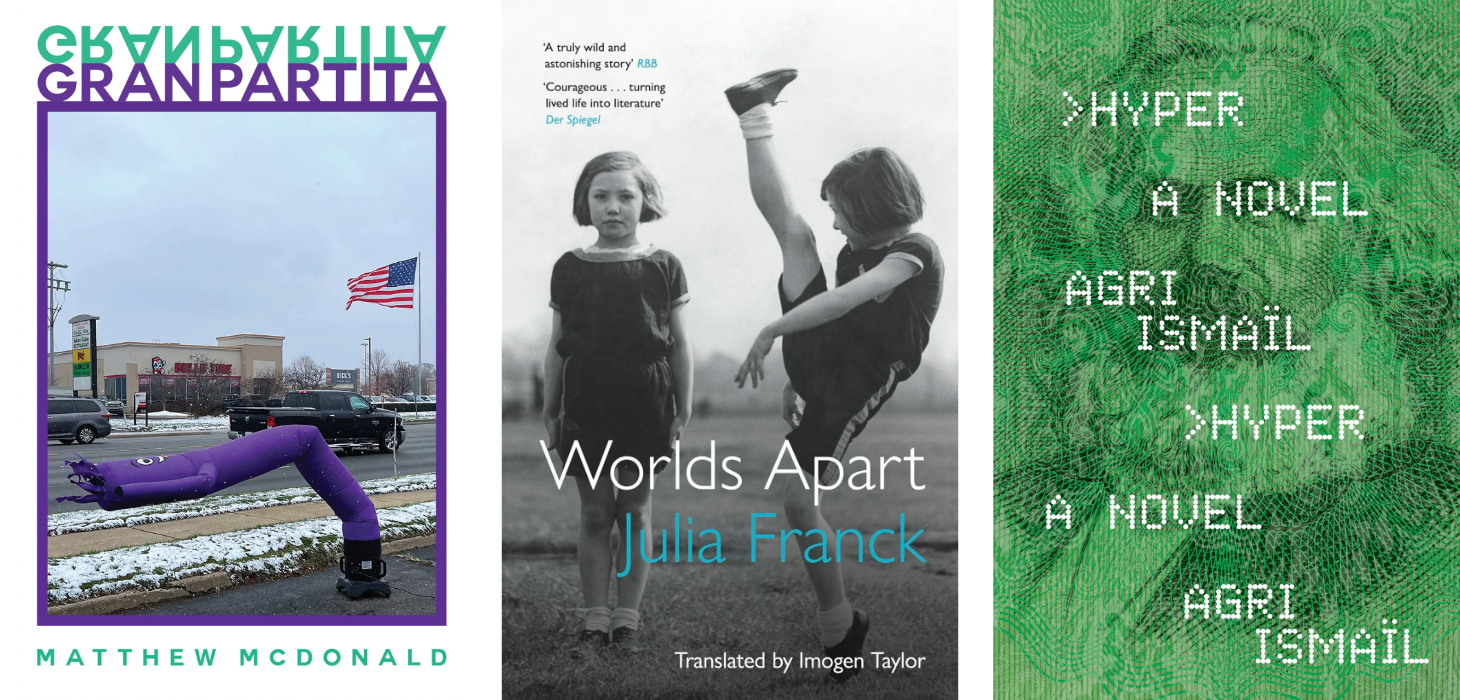
Gran Partita (Moist Books)
Matthew McDonald
This month, for the very first time, I read a book with one of those dancing tube guys on the cover. Matthew McDonald’s Gran Partita returns twice to the big purple character in question (‘an inflatable / dancing man / a.k.a. Tube Man / a.k.a. Air Spinner’), an unusual image but one surprisingly appropriate for the sensibility of the book. These poems are cheeky, gorgeous, strange; their speaker—a performer on the road—lets himself be tossed about in wind, shaken head to toe by vibrations, never quite in sync between his body and his breath. In other words: a poet.
McDonald, who was born in Australia, plays double bass for the Berlin Philharmonic; he is also founder of the online poetry journal berlin lit. Clearly he has many strings to his bow (sorry). Mixing high with low, lyrical with chatty, his excellent poems wander wisely between meditations on love and loss, classical musical history, scenes from the life of a traveling performer, and associative riffs driven on by language itself. Their tone is both tender and ironical, often lightened by moments of wry mockery and by intoxicating moments of equivalence or image: ‘Envy as the taste of lime // in the first mouth to taste lime.’ Or: ‘My eyes are small jacuzzis of news.’ Or: ‘Leaves drift onto my yoghurt / like pop-up ads for ad blockers.’
At the collection’s core, it seems, is the unsteady relationship between meaning and sound. There are vibrations, notes, and anagrams; one fine poem delves explicitly into the question of metaphor and music. Some poems are short, some essayistic. But the multipage poem sequences show McDonald at his best as he gathers up raw materials then varies them, inverts them, recombines them, transforms them. The title sequence, for instance, begins with Mozart and the mason jar: then it turns, and turns, and turns, and by the end, we’ve covered thousands of miles, and changed completely.
These are poems filled with feeling. They made me want to spruik them instantly. O Tube Man, o Air Spin Man, I would dance on the street dressed in purple all day if it made the people of Berlin buy your book. – AW
Worlds Apart (Moth Books)
Julia Franck, trans. Imogen Taylor
‘Had I never thought about writing about real life?’ This question confronts the narrator two-thirds of the way through Julia Franck’s autobiographical novel, Worlds Apart. The novel’s Julia is thirteen, living in her mother’s friend’s attic in West Berlin, and an avid diary writer. The friend, who knows the unique circumstances of Julia’s childhood—a precarious existence in East Berlin shuttling among foster families, her erratic actress mother, and her bohemian artist grandmother, followed by a radical transplantation with her mother and sisters to rural Schleswig-Holstein—offers Julia Frank McCourt’s Angela’s Ashes as a model for her own writing. The thirteen-year-old Julia, though book mad, doesn’t read it, rejecting the very premise. ‘What would I want to write about any of that? Autobiographical writing—it seemed to me perverse.’
Thankfully Franck, now an acclaimed German novelist, has since reconsidered. Throughout her career, she’s mined her life and family history for novels like The Blindness of the Heart, which won the German Book Prize in 2007. But no novel is as deeply autobiographical as Worlds Apart, which, translated with evident industry and ingenuity by Berlin’s own Imogen Taylor, takes on Franck’s early years and the family history that shadowed them in minute detail—and in micronarratives. It’s a novel that has as much interest in plot as the narrator Julia has in John Updike novels (i.e., none). Its interest lies rather in people, in its characters, against whom Julia defines herself (finally a reason for autobiography!). As Franck writes on the novel’s first page: ‘In discovering others, we assert our individuality. I am the unknown. We are all in flux.’
And perhaps it is this flux that is Worlds Apart’s governing principle. For all the keenly-rendered characters and intriguing episodes, there’s something slippery, almost evanescent, about the novel’s account of Franck’s first two decades. The diaristic level of detail doesn’t ground the novel as it shifts unexpectedly across time, refusing an easily discernible rhythm or logic. Instead, the details that Franck notices only emphasize how this novel is her own idiosyncratic reality. Truly: ‘our stories, our perceptions, are often worlds apart.’ We might mourn such distance in politics—but in literature like this, that’s a good thing. – SIB
Hyper (Coffee House Press)
Agri Ismaïl
Agri Ismaïl’s debut novel Hyper opens with Rafiq Hardi Kermanj, the scion of a wealthy Iraqi Kurdish family, haggling for a radio in Tehran. It is the late 1970s and Rafiq, a founder of the Kurdish Communist Party, has just arrived in exile. His timing is terrible: the shopkeepers already sense change is coming and soon the family will be fleeing again, escaping the revolution.
They manage to reach Britain, where Rafiq and his long-suffering wife, Xezal, raise their children in poverty in the south London suburbs. Rafiq clings to emigré Kurdish politics, while Xezal grows bitter with the thankless task of keeping the family afloat. The novel then refocuses onto that family’s three children as they scatter across the great financial capitals of the 2010s—London, Dubai, New York—with Ismaïl leaping between both characters and literary modes. His fractured, frenetic style bombards the reader with information and overlapping narratives, slowly tracing a finer and finer picture of the family’s dissolution.
As Rafiq fades pathetically into depression after a forlorn and feeble fight for communism and a homeland, his children struggle to accommodate themselves to the forces of unrooted globalized hypercapitalism, unable to see any possibility beyond it. The eldest, Siver, winds up a stifled housewife to a rich Iraqi businessman in post-invasion Baghdad, but runs to Dubai with her young daughter when he announces plans to take a teenaged second wife. There, she scrapes out a living selling luxury designer handbags to expats. The middle brother, Mohammed, hustles his way into a finance job in post-crash London despite having no degree, unsure at any moment if he’s a charming dealmaker or starting to lose to the cutthroat, desperate competition. Laika, the youngest, embraces a hyperonline cynicism, making a fortune from a pointless meme app called ‘Money to Burn.’ He lives a bizarre, lonely existence housesitting a Manhattan penthouse, trying to create an algorithm to mimic Goldman Sachs trades while watching Occupy Wall Street protesters on the street below.
It’s a brilliant depiction of dislocation and alienation, and not just through the Kurdish experience of statelessness, oppression, struggle and exile. The siblings’ world is also one of relentless global capital flows, where Rafiq’s ideologies—Marxism, nationalism—seem ridiculous and frustratingly immaterial. For them, financial fortunes are all that matters; yet what makes and breaks those fortunes is also inscrutable, capricious and incoherent. It takes an immensely talented writer to draw us through all this material and keep the story humming with dramatic tension. Ismaïl delivers. – Bryn Stole
Hot Sauce
A particularly explosive scoop just in. Last month, the media lit up when a young Frenchman was checked into a hospital with a live WWI artillery shell shoved up his… But rumor has it that this is an initiation rite for a certain elite group of bro-dernists. All is NOT quiet on the Western Front… Remarque-able!
From Kent: A certain giant of Scandinavian literature stopped over at a country house belonging to a British writer of some repute. But sources say the visitor overstayed his welcome. Between relentless moaning over bad reviews, endless dwelling on every slight misfortune, and a fondness for daily vices, the visit—which lasted an astonishing and unappreciated five weeks—‘seemed to the family AGES!’ Talk about a Struggle…
A best-selling novelist, who publishes their books under a now famous pen-name, and whose identity has long been the source of fevered speculation, has finally been unmasked: The Auflauf can now EXCLUSIVELY reveal to its readers that this writer is a surprising figure, well-known in their own right: the notorious and impressive [REDACTED - Ed.] – Marguerite McEnnedy
Got some more sauce for us? Shoot Marguerite a tip at theauflauf@substack.com.