
Ken Krimstein: ‘I wanted to look at Hannah from the other end of the telescope.’
The New Yorker cartoonist talks about Hannah Arendt on the page and stage

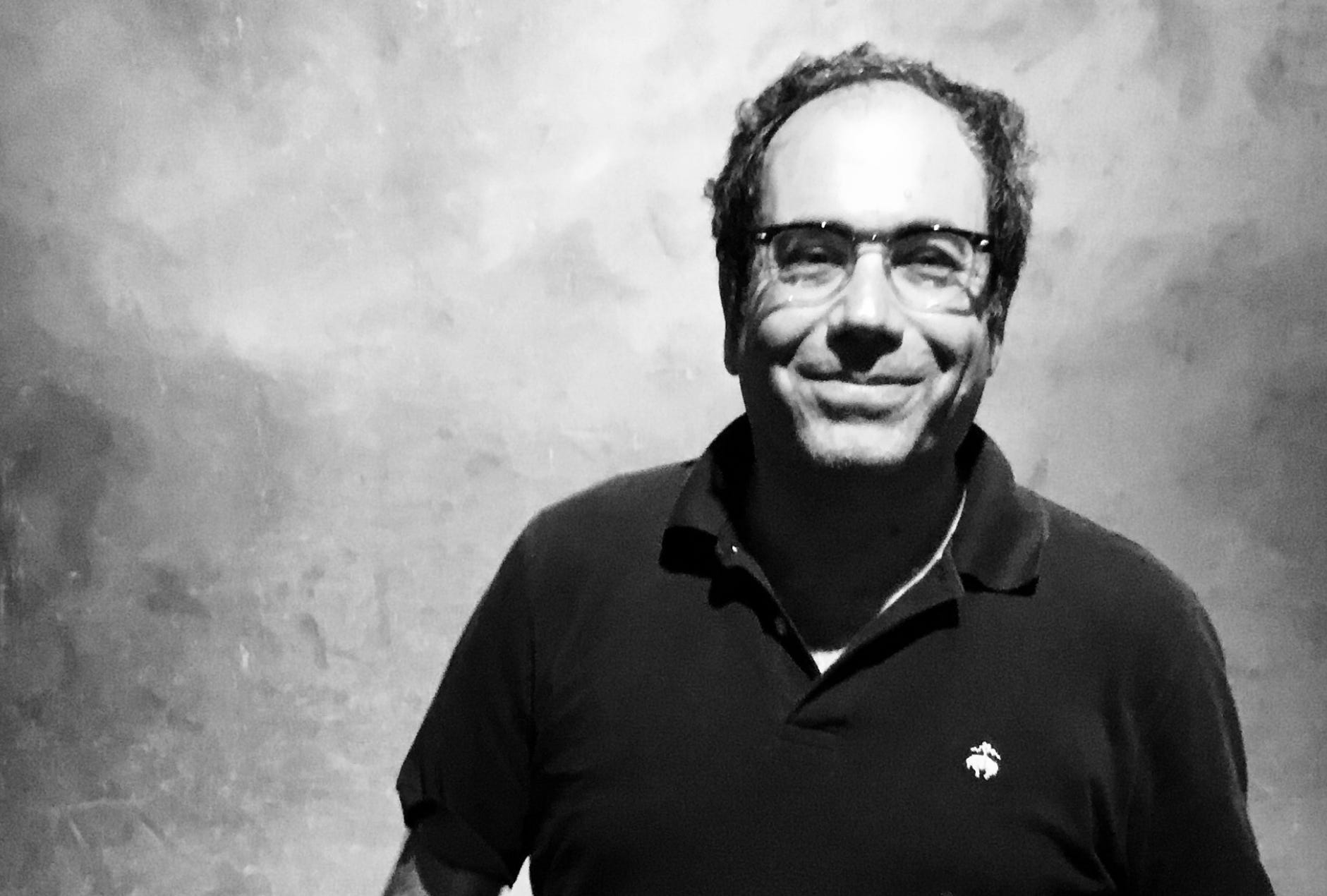
To explain his approach to writing biography, Ken Krimstein, the New Yorker cartoonist and graphic novelist, offers an anecdote about Martin Heidegger, Hannah Arendt’s mentor. ‘When he introduced his philosophy class at Marburg University’, says Krimstein, ‘he said something along the lines of: “Hello, today we are going to study Aristotle. Aristotle was a man. He died. Okay, now let's talk about his ideas.”’ Krimstein happily declares that he does the opposite. He’s interested in how ideas emerge not simply in conversation with the history of philosophy, but with lived experience. ‘What you had for breakfast, the weather, you have a two-month-old baby—all of this affects you as much as some abstruse Wittgenstein tractate.’ It’s an approach that Krimstein has brought to bear across his three award-winning graphic novels, and which drew him to Berlin as a fellow of the American Academy in 2025. His debut, The Three Escapes of Hannah Arendt (2018), has now been adapted to the Berlin stage, directed by Theresa Thomasberger at the Deutsches Theater. We spoke about the limits of a cartoonist’s knowledge, the challenges of translation across language and medium, and what Arendt might say to us now.
What we’re eating: chicken tikka and mango chutney (KK), boiled chicken and pickle (SIB)
What brought you to Hannah Arendt?
I have always wanted to try and tackle heavy subjects within the comics or graphic novel medium because I’m very interested in philosophy and history, and I think everyone else should be too! I felt it would be a really interesting challenge to use the tools of comics, which are humans—people, stories, a little bit of humor, the ability to break the fourth wall—to try and communicate a complex subject. One of my mentors in cartooning, the late great Sam Gross, said two things to me [when I was thinking about doing this project]. One: go for the heavy stuff. I found a lot of ideas [in this way] even when I was doing cartoons for The New Yorker. I’d pick up a medical journal and think ‘oh, wow, that’s weird’—and get an idea. And the second, and even more career-defining thing was ‘You’re a cartoonist, Ken. Cartoonists know everything.’
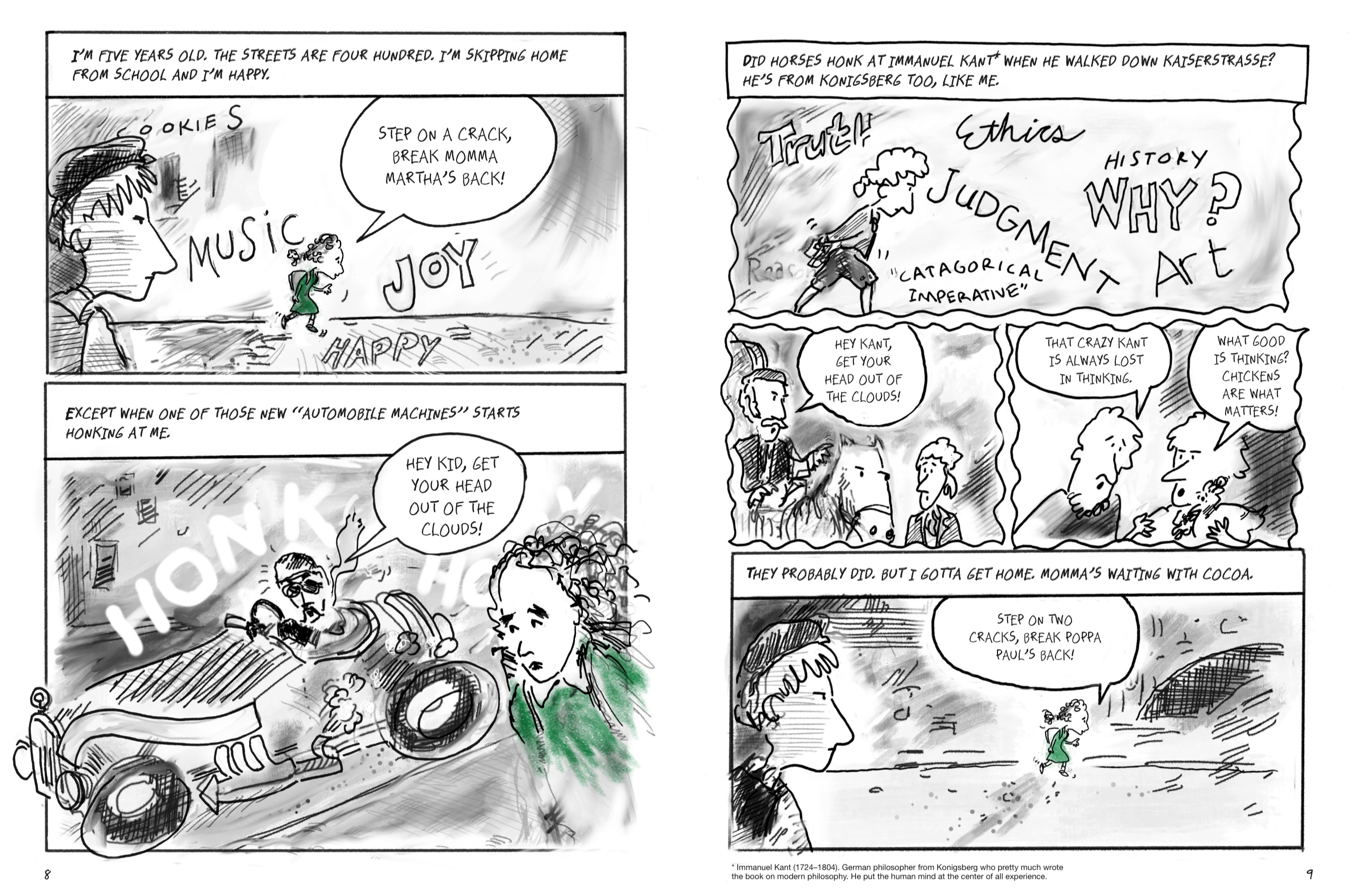
I was also fascinated by this person that, growing up in America, had always been in the ether. People kind of knew her—the ‘banality of evil’, things like totalitarianism—but no one really knew her. I was a history major and I studied philosophy, but I was especially curious about her creative process. I wanted to look at a philosopher as a creative person. Where do their ideas come from? The minute I scratched her biography, I found all these incredible connections to things that I’ve always been very interested in: whether it’s Weimar Germany, the Café Romanisches—which I didn’t even know about, but I was familiar with the people who were habitués there—New York City, Greenwich Village, the Cedar Tavern, the Upper West Side where I lived, or the University of Chicago, the area where I now live. And then as I dug into her ideas, I found them so challenging and so refreshing and so connected to her life journey. And then I thought, what an arc of life! From pre-World War I, when there were horses and carriages still running around, to after the Ramones started playing at CBGBs and Nixon had resigned.
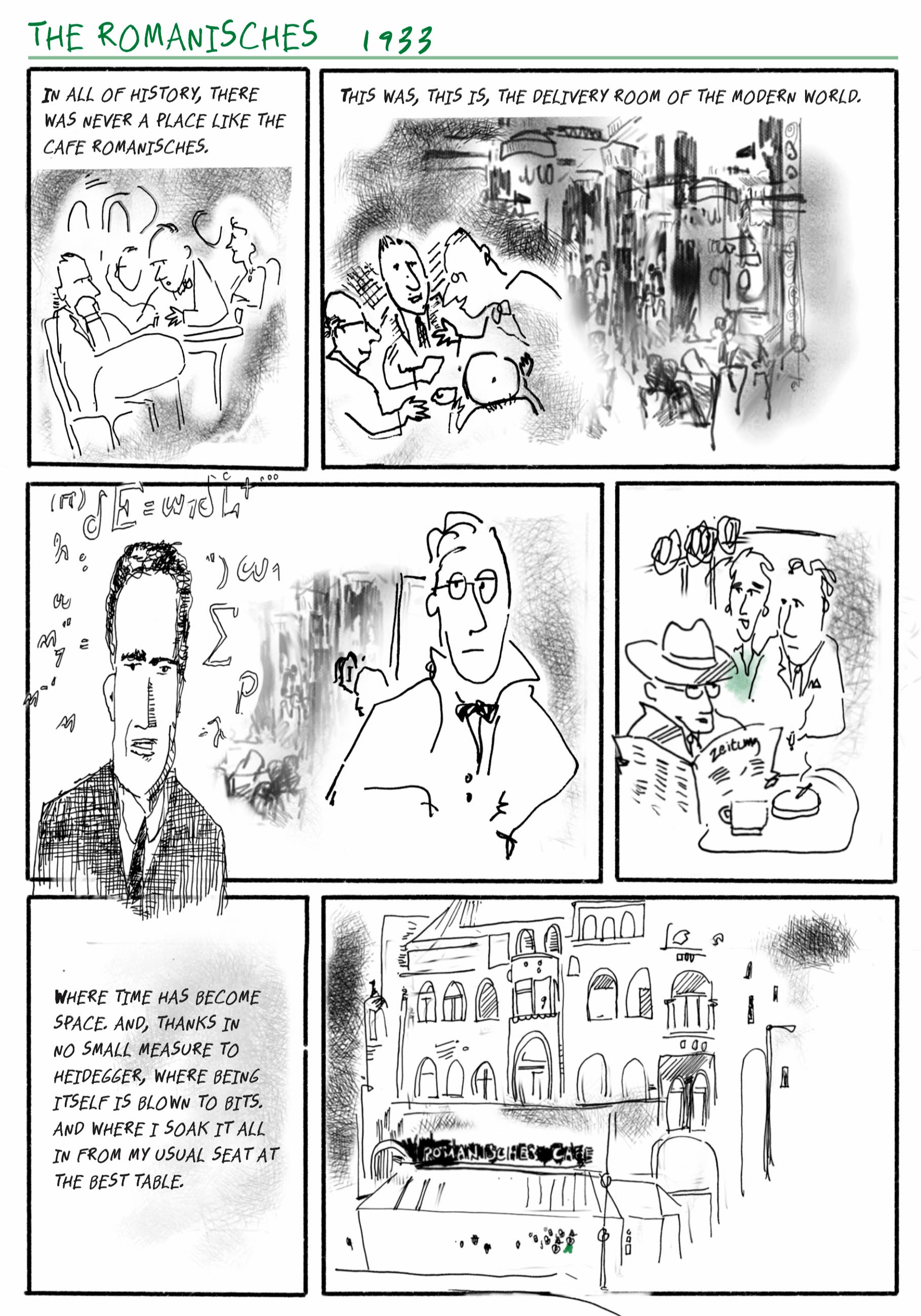
As I was reading the book, I was wondering how you think about the relationship between image and text—in particular, how do you translate the difficult conceptual thought of Arendt into the world of cartoons?
The core of writing a biography, for me, is: who is the person—as much as we can ever know who a person is. So I had to figure that out, by reading and rereading and rereading. And then rereading again. Also, since she didn’t pass away that long ago, there were a lot of people around who knew her. I got to interview some people who studied with her and worked with her. I picked up little nuances in the life story that didn’t fit. When I find one of those, then I know that there’s something behind that. So those are the things that I’m trying to unravel.
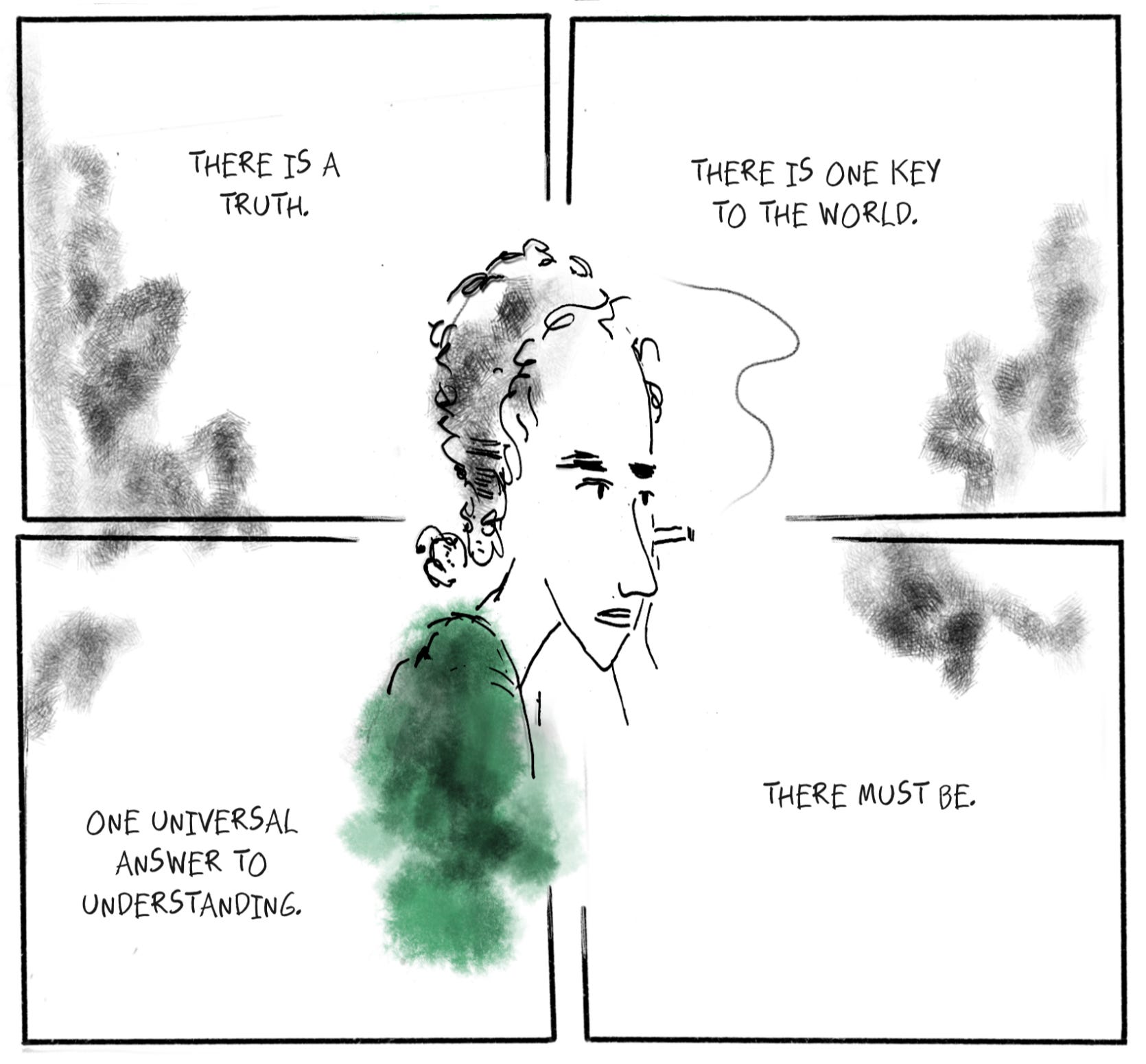
But then it’s complicated. Her writing is all over the place. She prided herself on not being doctrinaire. She stood for that way of thinking that said, I don’t want to be ‘in any school that would have me’. I was studying Leo Strauss, a philosopher at the University of Chicago who supposedly dated her and was rejected. Strauss was completely opposite to her. He had a whole cadre of acolytes—you know, ‘light my cigarette’, ‘carry my briefcase’—which is how I think Heidegger might have been too. That was the thing [to do]. And she didn’t have that. She didn’t have a circle. So I had to figure out what her ‘North Star’ was, or the unifying principle that I could drive to in the narrative. For me it was her distinctive notion of thinking: thinking through, thinking without banisters, thinking as a dangerous activity. I kept coming back to that. Once I had that throughline, I had to ask myself: what in her life gave her that insight? And then the pictures just came [from there].
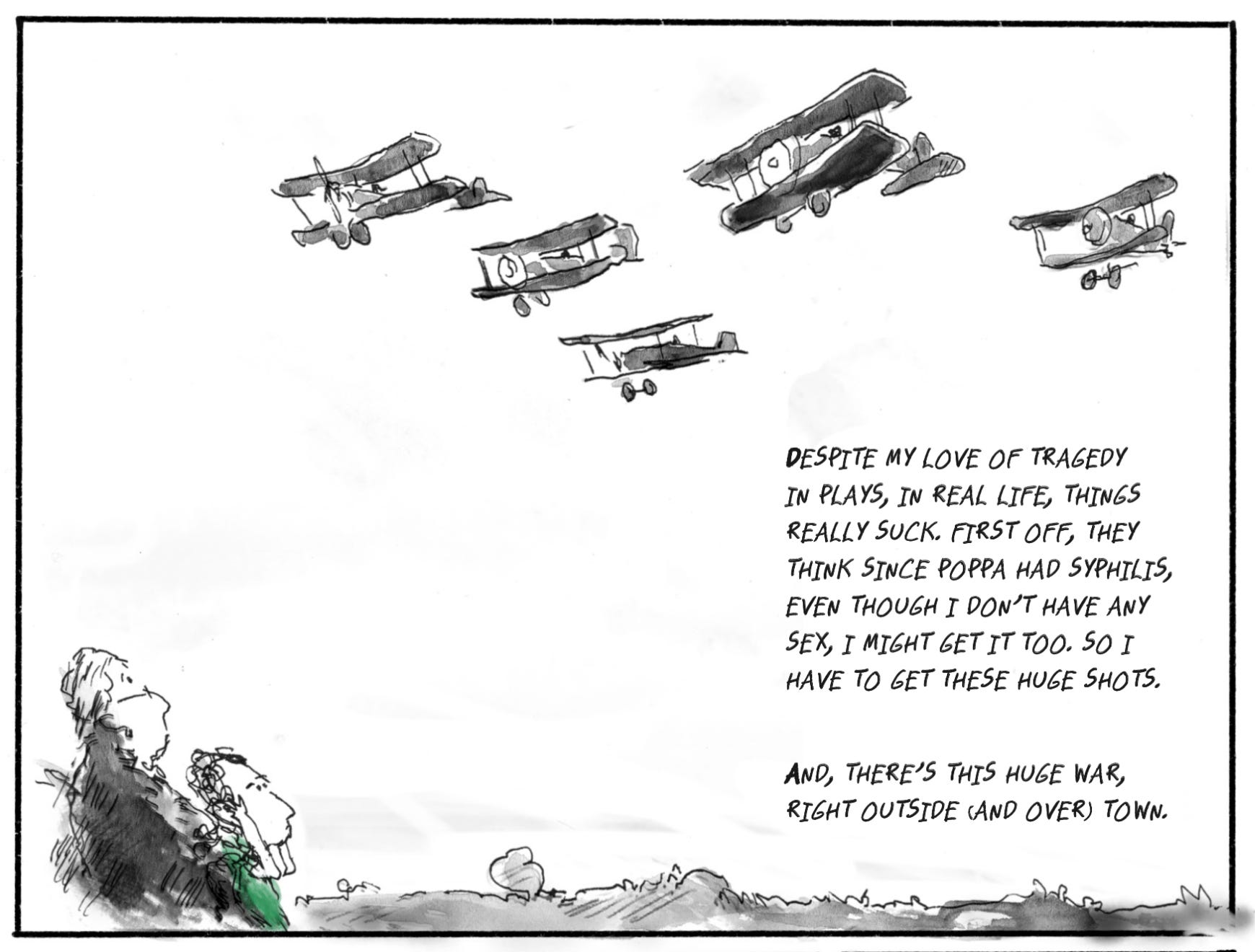
One image I found that was quite striking was that, when she was a little girl, the Great War—or World War I, as we call it—was happening right over her head. She would go out there and see airplanes. I mean, they didn’t even know what airplanes were. It was horrifying and scary to a little girl. So I had to show that. I had to put myself in the position of the people at the time. They didn’t call it World War I. They didn’t know there was going to be a World War II. They thought it was the Great War, the war to end all wars. They were being confronted by an industrial war and it was absolutely horrifying to them. This image popped into my head of her as a little girl with her mom in a field looking in the sky, seeing warplanes flying over them.
What do you think about the translation of your work? The German and French translations of the text, for example, choose not to go with a literal translation of The Three Escapes of Hannah Arendt, but instead make it into The Three Lives of Hannah Arendt. Is there something lost in that choice?
A very big, important part of her thinking is she’s very action-oriented. She’s like ‘action action action’, and it’s hard to think of a dramatic incident more action-driven than an escape. So I liked ‘escape’, but once I had come up with the hook, I had to deliver on it. It took me a long time.
I remember reading Aristotle’s Poetics, his book about the rhetoric of writing tragedies. Everything was a three-act structure. Three is a magic number. I had the first two that were very neat. The third one, which is the ultimate one… That took a while for me to figure out. The book has been translated now into something like 12 languages. I keep hearing about different countries, thank goodness, that keep translating it. And there are nuances in every language.
When the book was translated into German—and Hans Zischler did a beautiful job—there’s a German expression called ‘thinking through’ as in, ‘I need to think this through’, and all the Germans seem to know it [durchdenken]. But when it was translated into French, I got a call from the French translator. She said, ‘What does “thinking through” mean?’ She had no idea. There’s no such concept. And I make a little joke about translation in the book, when I compare the different ways that the word butterfly is said in German and in French. So, these kinds of nuances of language are very, very important.
Were you thinking about the possibilities for this to be staged or adapted as you wrote it? The text feels like it’s bursting with so much energy that it’s ready to enter into other mediums as well.
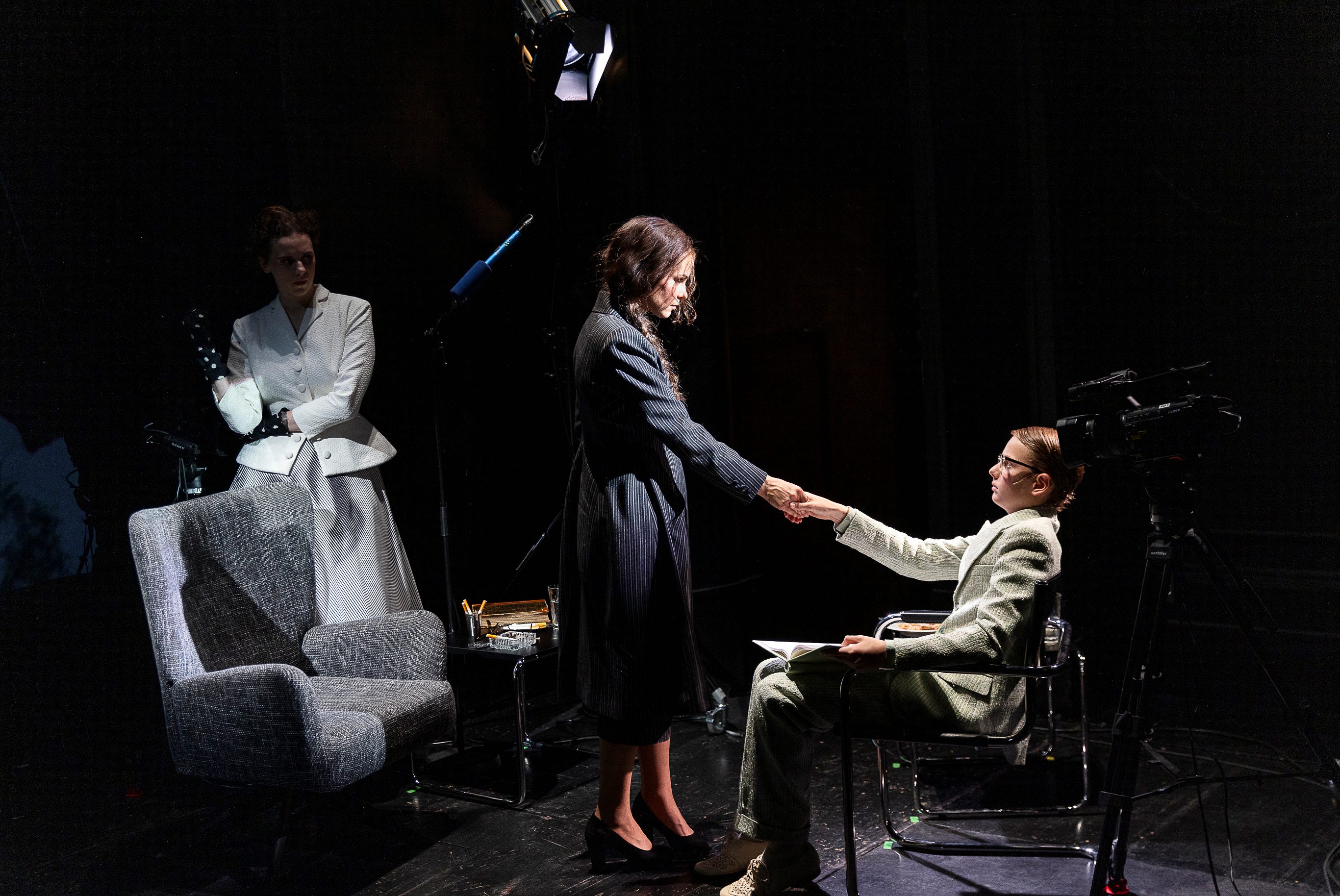
Well, I couldn’t really think about that when I was making it. Every medium has its own possibilities, which are often defined by its limitations. I [structured it as] a dramatic incident, which is [a narrative] where somebody has to slay a demon, or they’re flawed, or they have to learn, or they have to grow. I think that probably makes it feel like it could work on a stage. I was [already] thinking about it when the Deutsches Theater approached. It makes a lot of sense, because Hannah—and forgive me, I sometimes refer to her as Hannah, I know her so well—was very much about showing up in public space. I think she would be horrified by the anonymity of social media, where you could have a fake name and say fake stuff and have fake bots. Her philosophy is very much about performance, being face to face, mano a mano. And theater is like that. You’re in a room with human beings—in time. So I think the encounter with the experience is very fitting.
Having said that, if it were done in a film or a television show, it might be done differently, because those media have different powers. I liked the fact that—as opposed to a documentary film—in the book, you can have a narrative drive, but then you can also stop and go back and flip through the pages, or you can look at footnotes, or you can just go to Google. I like the fact that people can address the book in any way that they want.
How much are you involved in the process of adaptation?
I’m a creative artist. Theresa, the director, she’s a creative artist too. She’s a master of her medium—I do the best that I can. (laughs) I find that when you let people go, that’s when they do their best stuff. But I just wanted to give her as much of my understanding into who this person was and how she dealt with the world, because I felt that Theresa was responding [to it]. She’s a philosophy major too. I could say I’m just a cartoonist—or I could say, like Sam Gross, ‘I’m a cartoonist. I know everything.’ I wanted to make sure that we were on the same page and that we were trying to answer the same mysteries. And I felt that we were.
But when I started seeing some of the character design sketches and some of the ideas, my mind was just blown. I like comics because it’s kind of a bastard medium, and I think graphic narrative theater is too. It’s the vision. David Mamet, a Chicago guy who became a director, often says: On the stage it’s about the dialogue, but in the movies—and in cartoons—it’s also about the pictures. I think a good theater director knows how to use the limitations of the stage to spark the imagination. Theresa got the fundamental thing. I wanted to look at Hannah from the other end of the telescope, from the life to the ideas rather than, as typical, from the ideas down to the life. And I think theater at its best is about life.
You’ve now seen the play. Was there anything that it brought out about your work—or Arendt’s thought—that was surprising to you?
Seeing ‘Hannah’—or, spoiler alert, ‘Hannahs’—strutting and fretting, speaking German, alive, in Berlin: it gave me the chills. Not to mention the incredible performances. I was stunned, and delighted, that some of the things that I wrote and drew that made me laugh in my studio in Chicago made an audience full of people in her one-time home of Berlin laugh too. Writing a book is a very private performance—my words and pictures are at play in the mind of one person. When humans inhabit the tale in front of other humans, it sort of takes off into a new social, public realm—as Hannah might have said.
Obviously it’s been a wild time, geopolitically, close to your home, in Chicago and Minneapolis. What do you think Hannah Arendt would have made of what’s going on? There’s been a bit of an Arendt-naissance since the first Trump administration, but do you think there’s some aspect in her work (or her life and work) that’s been overlooked and that we should pay particular attention to right now?
She believed in people showing up and talking to each other and debating each other with respect and dignity. Dignity—the concept seems almost quaint, yet to her, it was so core. She would be horrified, I think, at the narrowing of political views: she always felt that politics and truth were always somewhat at odds. She was skeptical of government funnelling truths that suit them into the public discourse. One thing that really resonates now is her saying—and I paraphrase but it’s her meaning—‘the real danger of lying in politics isn’t that people believe the lies, it’s that they begin to believe in nothing at all.’ I think she’d be the first person to wish that all of her thinking on totalitarianism and evil would have been rendered obsolete by now, but, as she wasn’t prone to wishing, I think she’d realize that, alas, her thinking is still more than relevant.
The only possible good thing is that she might have cut down on her smoking, and that might have given her a few more years with us.
Die drei Leben der Hannah Arendt is currently on at the Deutsches Theater.
I have known about Krimstein's work for some time. I just haven't gotten to hisn books yet. This is a push to start reading them. There have been a few graphic novels that have been turned into plays which I wrote about last year including Berlin by Jason Lutes. https://jsandlergraphicmemoir.substack.com/p/from-berlin-to-fun-home-graphic-novels
This was an excellent read!