

June Books: Rauhut, Miller, Hoyer
The GDR rock band Silly, poems by Alice Miller, and Katja Hoyer on the rise of fascism in interwar Weimar


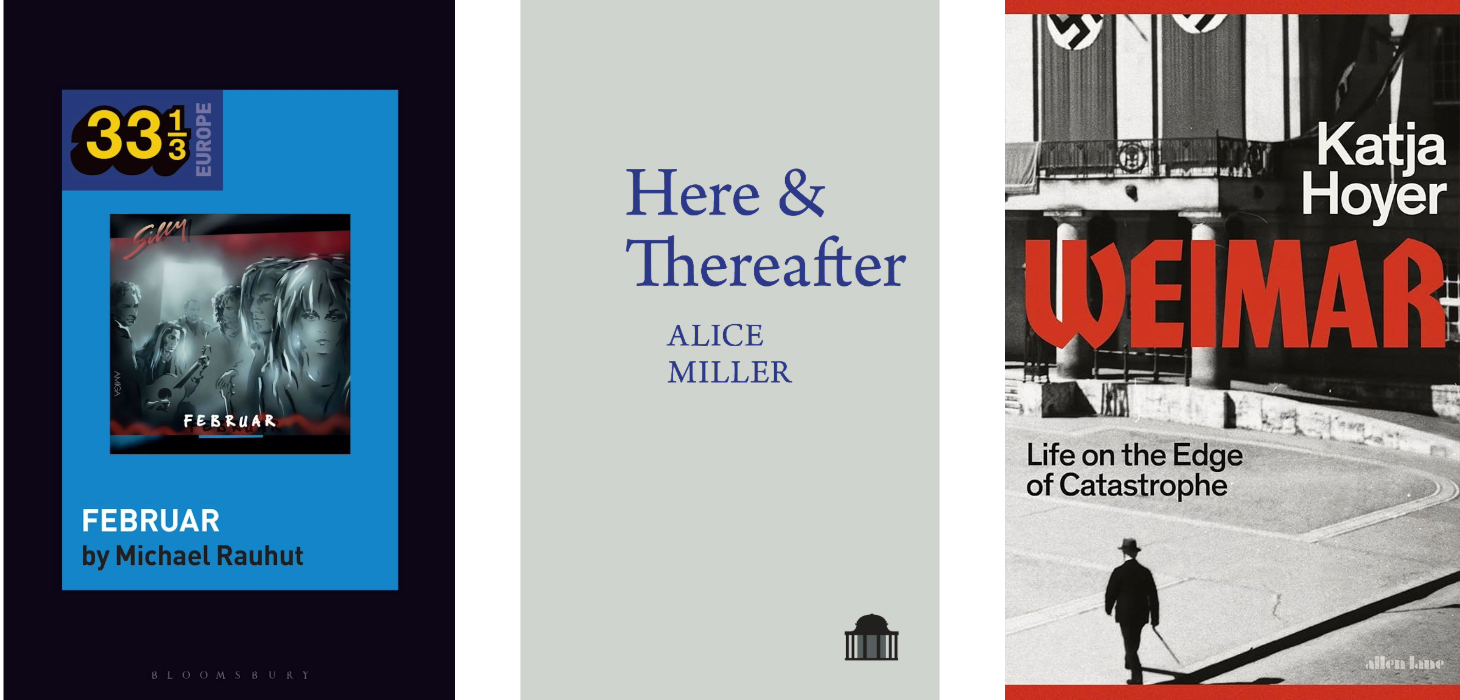
Silly’s Februar (Bloomsbury)
Michael Rauhut, trans. Noah Harley
Tamara Danz deserved better. One of the most talented rock stars ever to call Berlin home has been memorialised—not by a grand boulevard, Platz, or music venue—but with a piddling little street, which is now one of the most depressing you will ever see, rising as it does from the East Side Gallery (between Uber Eats Music Hall and Pirates) past Zalando and the East Side Mall to end, just north of Matrix, at the construction site for the new Amazon tower. That sentence alone is enough to send indie Berliners of a certain age into a spell of Sebaldian melancholy so extreme it can only be resolved by a twenty-minute angry nap.
Because here’s the thing: Danz was dynamite, and she was only getting better when she died aged 43 from cancer in the mid-1990s. Her band Silly was fantastic as well, leagues ahead of the other GDR rock groups. They remain beloved by eastern Germans, who flock to their revival concerts, put on with new vocalists—but are surprisingly unknown among everyone else.
Enter Michael Rauhut, with his contribution to the 33 1/3 series of short nonfiction books, each dedicated to one album. Rauhut, a professor of music based in Norway, grew up as a rock fan in the GDR. His book is both analytical and passionate, reflecting a deep appreciation for Silly as well as a respect for the nuances of East German life. (Dieser Michael hat den Farbfilm nicht vergessen.) Rauhut makes excellent use of the format, taking Silly’s album Februar—recorded shortly before the fall of the Wall—as his starting point for fascinating excursions into GDR rock history, Silly’s complex relationship with the regime, and the musical influences behind the album, from members’ varied rock and funk backgrounds to foreign acts like Jaco Pistorius and Yes to rival lyricists Werner Karma and Gerhard Gundermann.
We read about band politics; we read about politics. Rauhut weaves an engrossing narrative of the border-crossing manoeuvring that made Februar (an East-West coproduction) possible. We also follow Silly into the post-Wall era, when Danz emerged as an eloquent critic of Western arrogance and of the unequal path that reunification was taking. In general, the band refused to play dissident for Western media, even as they made increasingly bold stands against the Party. Rauhut argues convincingly that, while Februar has often been read as protest music (or as a soundtrack to reunification), the album is more existentially ambitious than it is locally political.
Rauhut also offers individual track notes, well worth reading between listens. This is beautiful, searching, mongrel music; it lives between fury and tenderness, loyalty and solitude, disillusionment and the fear of belonging to nothing at all. Alles wird besser aber nichts wird gut (‘It’s all getting better but it won’t end well’): these lines were written in 1989 but you could equally listen to them today, on your headphones, while walking up Tamara-Danz-Straße, towards Berlin’s newest world-class skyscraper. – AW
Here & Thereafter (Liverpool University Press)
Alice Miller
Over the last decade, Alice Miller has published several collections of poetry concerned with historical, ecological, and poetic crisis. Her newest, Here & Thereafter, is at once a chronicle of early motherhood and a foray into the uncertain terrain of her own family history. What she knows: the location of her family’s shop, ‘some steps / from what is later known as Bebelplatz’; the outlines of her Jewish grandmother’s journey from Braunschweig to London to Norfolk Island to Te Whanganui-a-Tara, Wellington; the fact that her father, traumatized by the Blitz, didn’t speak until he was five. Yet when she tries to picture her grandmother alone in London: ‘How lonely is she? That’s not recorded.’
Is that, then, poetry’s job? One of Miller’s epigraphs comes from Jane Austen’s Northanger Abbey, as the protagonist explains her preference for Gothic romances. ‘That is, I can read poetry and plays, and things of that sort, and do not dislike travels. But history, real solemn history, I cannot be interested in. Can you?’
Miller is more omnivorous than Catherine Morland. There is poetry, plays, and travel here, but real solemn history is what weighs over this collection. Not just the past, but the present that will be the past (Covid, Ukraine, Palestine). ‘Dear Unfinished City’ is an ode to a beautiful, immanent Berlin—to its ‘dear airports masquerading at parks’ and ‘dear coin-coloured light’. That poem is immediately followed by ‘Push Here’, where the past returns in a rush. The cruelties experienced by her family seem to recur, unanticipated, in Germany’s response to Gaza. The speaker is stuck, buzzing:
Impossible
to sit still on mornings
like this, impossible to hold

a baby, impossible (not)
to leave the house.
That space between ‘hold’ and ‘baby’ is weighty, full of all the things that cannot be done, that itchy feeling that comes from looking into the abyss of one’s own powerlessness. And yet the baby is there, concrete, something to look at and hold, not quite world-historical but incontrovertibly a world. The ghosts of the past live alongside the demands of the living. In ‘The Origins of Totalitarianism’:
It seems somehow wrong
that these worlds are separate: Arendt
thinking through the crisis of the
century and my son taking
my hand at the zoo, pointing up at the owls.
Can there be poetry—can there be childhood wonder—after Auschwitz (after Gaza, after Donetsk, after environmental collapse)? Yes, as Hans Magnus Enzensberger insisted: it is, in fact, a duty. Miller takes that call seriously. Her poems manage to hold the private, the public and the historical together, even when their contradictions can’t be resolved. – MM
Weimar: Life on the Edge of Catastrophe (Penguin UK)
Katja Hoyer
After a few decades off, historians are getting explicitly political again. On left and right—in Timothy Snyder’s broadsides towards the Trump regime, say, or the faintly ludicrous pro-Brexit Historians for Britain movement—they are seeking a role in our increasingly divided political discourse.
Katja’s Hoyer’s study of interwar Weimar is an unabashed attempt to make a similar contribution to the contemporary debate in Germany. ‘If we are to avoid the mistakes made by people in the past,’ she writes in the introduction, ‘the first step is to understand why they were made’. A question therefore ran through this reader’s head over the next 400 pages: can a crowd biography of a small but culturally significant town really help us understand why people today vote for the AfD?
Her unlikely protagonist is Carl Weirich, a bookbinder and stationery shop owner who stands as a representative of ‘ordinary’ Weimar. His life is shaped by the tragedy of losing first his daughter then his wife around the end of World War One. Alongside him, more prominent Weimar residents—from the aging Elisabeth Förster-Nietzsche, the philosopher’s sister, to future Hitler Youth leader Baldur von Schirach, among many others—shape their identities in the tumultuous world of Weimar’s eponymous republic. This mixed cast allows Hoyer to shift effortlessly between the macro and micro of history.
But it is in the micro that this book’s power lies. Weirich and his fellow ‘ordinaries’ find themselves confronted by events: initially apolitical, after years of economic uncertainty Weirich celebrates Hitler coming to power in 1933. Hoyer never allows this to be seen in purely structuralist terms, whereby Weirich would not be the master of his own decisions. She later points out that he never once questioned his own culpability in the system, even when he later came to doubt it. That said, she does not condemn him either. What marks this book out and indeed makes it interesting for our contemporary political moment is her alertness to each individual’s unrationalized, often fleeting motivations.
It is in people like Weirich that Hoyer ultimately perceives a real, if sometimes passive threat. They are the route by which dangerous ideas become real. Hoyer writes grippingly, and her ‘bottom up’ approach is elucidating. Yet we never do hear exactly how the danger of fascism could be quelled today. Is that a failure on Hoyer’s part? Perhaps it is instead a perfect example of a good task for history books—to show the past in clear yet nuanced terms and allow others to make decisions about what to do with it. We do need solutions for the mounting fascism of our own moment, but Hoyer’s description of the rise of the Nazis shows us that motivations are individual and influenced by bigger factors. No easy answers follow, but maybe that itself is the point. – John Owen
Save the Date: On September 19, The Auflauf will be celebrating its first six months with a night of reading and hanging out at Lettrétage (Veteranenstr. 21). Further details to come!
Hot Sauce
Editor’s Note: There will be no Hot Sauce this month, pending legal action from our former Pan-European Gossip Correspondent, Marguerite McEnnedy. Unfortunately undertakings have been stalled by her lack of response. It is possible she has used all her mobile data playing mahjong on her phone; if any of our readers have a way of contacting her, please direct her to the nearest hotspot.