

July Books: Finlay, Emmerling, Birrell
A frenetic Berlin tech satire from Susan Finlay, Leonhard Emmerling's erudite account of idiocy, and Rebecca Birrell on art, fascism, and polyamory in interwar Berlin


Save the Date! On September 19, The Auflauf will be celebrating its first six months with an evening at Lettrétage (Veteranenstr. 21), featuring readings from Hilda Hoy, Kate McNaughton, Rob Madole, Tobias Ryan, and Dženana Vucic. Details to come.
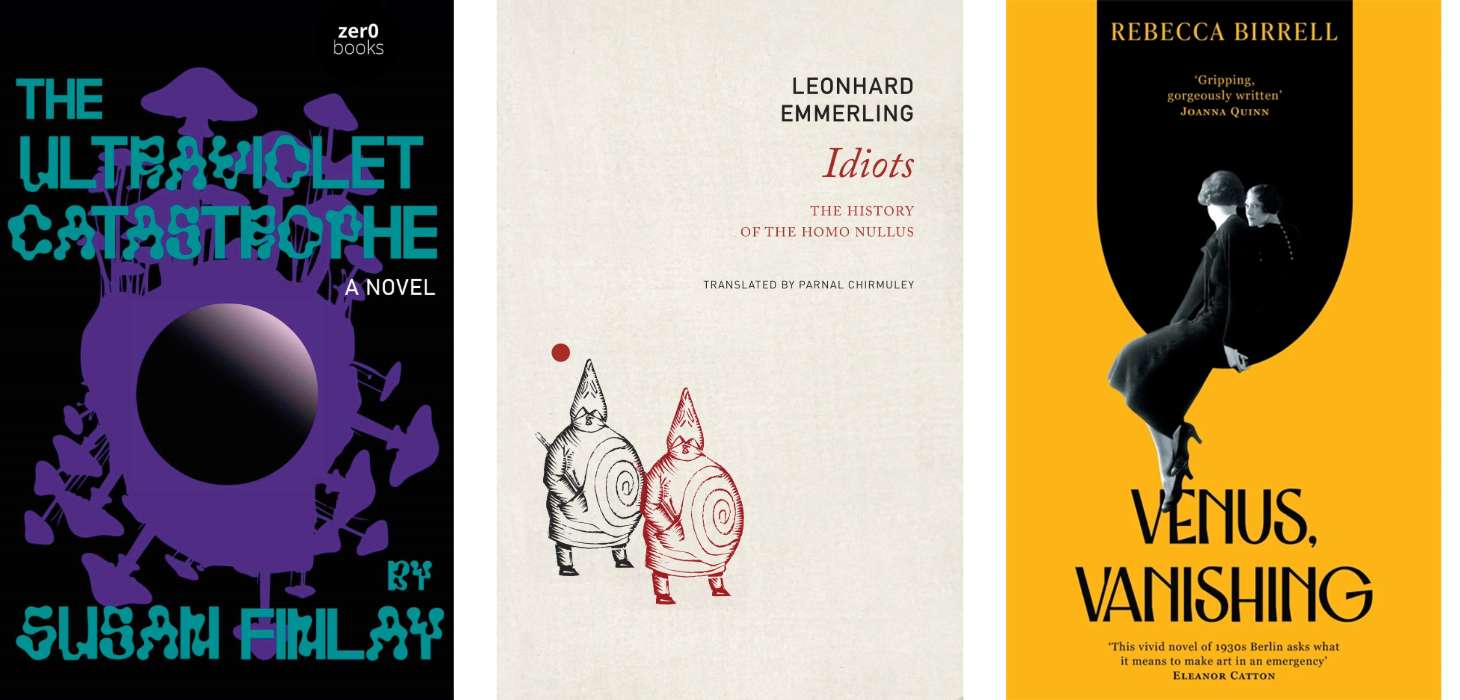
The Ultraviolet Catastrophe (Zer0 Books)
Susan Finlay
The subtitle of Susan Finlay’s newest novel is ‘A Culturepreneurial Horror’. Readers who find this kind of neologism amusing are in for a very good time; readers who don’t might need to conjure some patience.
The Ultraviolet Catastrophe, in more conventional terms, is a satire, using tropes belonging to dystopian science fiction to parody the tech world. Set in Berlin in 2023, the plot revolves around Hugh Snell, a scientist at AstroLabs™, a space start-up run by the tech bro overlord Lex Ramesses. Ramesses pays his employees in a cryptocurrency called Prosperium, which he promises will work on Proserpina, a new inhabitable planet he has just purchased but no one can get to yet. Finlay has a knack for mimicking the soulless consolations of big tech: to boost office morale, Ramesses sets forward the mantra, ‘Chill, ideate, and enjoy!’
Snell, 37, American, collects old synths and obsesses over his dwindling sperm count. The apartment he shares with his beautiful and more competent wife Petronella has become a nonconsensual WG as it fills up with the polyamorous, the Astro-Marxists, the vegans who serve burned vegetables caked in dirt. Outside, there are gen Z influencers, crypto bros, corporate hacks, gamer bros, Berghain clubbers, drug-addled wastoids. Music is ‘post-instrumental’, the preferred social media channel is called ‘ZeitHeist’, the décor is all Scandi, failed fashion designers might rebrand as a ‘Counter-Productive Arts Practitioner & Facilitator’, and identity is a performance art. ‘I’m not non-binary,’ says a character named Yves, Snell’s least welcome flatmate. ‘I’m Euro-plural. Yvette is my deadname, because the UK is a dead place.’
Finlay is a long-time Berliner. Her investment in the city—her nuanced understanding of its character, its creative promise, and its subcultures—imbues the book’s sometimes hysterical energy with real edge. Berlin here is alive, flat, chaotic, ridiculous, utopian, kind of wonderful, deeply imperiled, and perhaps truer to life than any story about an emotionally distant expat who comes to the city to lose themselves.
Is the plot of The Ultraviolet Catastrophe more difficult to follow than it could be? Are there perhaps too many characters? Can the story drag under so much detail? Do Hugh’s self-conscious asides take the reader out of the action somewhat unnecessarily? Yes. But ultimately, who cares! The book certainly doesn’t, it’s busy having a good time. So you can fight or you can lean in, stop worrying, and light up a Shroomcyclidine cigarette. Chill, ideate, enjoy! – Julia Bosson
Susan will be launching The Ultraviolet Catastrophe at 7pm on July 16 at Spike Berlin (Goebenstr. 22) with an evening of readings and performances. More info here.
Idiots: The History of the Homo Nullus (Seagull Books)
Leonhard Emmerling, trans. Parnal Chirmuley
History, like the motorway, has no shortage of idiots. But the term is slippery, capacious—far more deft than the thickos it describes. Idiot derives from the Greek ἴδιος (idiōs) or ἰδιώτης (idiōtes): the former denoted that which is particular about a person or thing, the latter referred to someone who holds military office but does not participate in politics. Idiōtes, however, was also the name for an amateur speaker who presented their views and demands before the polis. In the protean origins of idiocy, then, we find concerns about privacy, peculiarity, and the participatory ideals of democratic life.
With Christianity came the idiotá, a social outsider embodied by Saint Francis of Assisi, who made ignorance into a form of apostolic fidelity. What else to call a man who rejects his father, his garbs, and a sizable inheritance, all to follow the path of Christ? Whereas Francis abdicated knowledge, the fifteenth-century German Catholic bishop Nicholas of Cusa fashioned idiocy into a via negativa for approaching the infinite unknowability of God. Through intuition and abjuration, the idiotá sidesteps the usual dialectics of inclusion and exclusion, affirmation and protest, and walks a third way all his own.
Who is the idiot not? Other historical dummies can appear similarly asinine, but clowns, buffoons, and such are deficient in their own ways. The fools we know from literature (Feste, Till Eulenspiegel) have more interest in social criticism and carnivalesque inversions of power than our small-minded wantwit. Nor is the idiot entirely flush with the salos: a figure of holy insanity in early Christianity who reflects the lunacy of daily life back into the marketplace. Idiocy, we learn, is closer to Andy Warhol’s art, certain forms of punk music, and the preoccupations of Tarkovsky’s films. Lost to the world, the idiot neither critiques nor endorses. Idiocy is simply indifferent: sometimes radically so, sometimes in the service of ‘unambiguous evil’.
What ultimately emerges in Leonhard Emmerling’s Idiots: The History of the Homo Nullus (2026) is a story about Western secularization. From out of the disenchanted carcass of the Holy Fool—drawn and quartered across the gears of Enlightenment—comes an institutionalized idiot, a cousin in kind to the imbecile and the madman. And this brings us up to our own era, in which the descendants of Ubu Roi have been elected to office, peddling their lack of aptitude, education, and expertise as a form of authenticity and authority. Despite the promise of stoogery, Emmerling’s history is profoundly unfunny. But so too is the trajectory of idiocy. What was once a mode of unknowing tinged by divine grace has decayed into a politics of ignorance, selfishness, and unreason. – Hunter Dukes
Venus, Vanishing (Picador)
Rebecca Birrell
Art historian Rebecca Birrell’s debut novel Venus, Vanishing begins at the tail end of the Weimar Republic. Hannah Sherman, a young, Jewish seamstress living in Berlin’s Scheunenviertel, has just refused a marriage of convenience and left her family home in favour of an independent life as an artist.
In a nightclub called the Sybil Vane—a cheeky twist on Schöneberg’s Dorian Gray—Hannah meets dancer Charlotte, who becomes her lover. So does Saul, an employee of the Kaiser Friedrich Museum and the novel’s font of art-historical wisdom. Hannah also becomes less happily involved with the wealthy, older Elke, a former customer who becomes her lover, patron and muse, sitting nude as Hannah’s model for the Venuses of the novel’s title in exchange for an allowance.
At first, Elke’s pay cheques seem to be an act of charity, intended to give Hannah the freedom to flourish as a painter. The first sign that something more sinister is at work is a haunting, memorable scene in which Hannah’s work is publicly exhibited for the first time, hung beside a crude painting of a Jewish woman coveting the milk of hard-working Aryan farmers.
What unfolds is a conspiracy to exploit Hannah’s talent by modifying her paintings and selling them under the male pseudonym Answald Dietrich. As ‘Dietrich’ becomes a court painter to the ascendent Third Reich, the novel’s real conflict emerges: will Hannah’s paintings be remembered as the volkish kitsch of an Aryan man, or the sensuous, avant-garde nudes of a bisexual, Jewish woman? This conflict drives the plot: Elke attempts to silence Hannah with bribery and threats of violence, and Hannah and Saul go public, distributing an explosive manifesto declaring: ‘If the star of the Great German Art Exhibition is a Jew, then—contrary to the claims of our nation’s great minds—blood is irrelevant to art.’ It is also central to the form of the novel, which, in Dietrich and Hannah, pits two kinds of fictional painter against each other. The former is an avatar for the erasure of Jewish artistic life, the latter a means of recovering it.
As a historical note explains, Hannah is fictional, but she is a composite informed by the works and biographies of many real Jewish women artists whose careers and lives were destroyed by the Third Reich: Charlotte Salomon, Chana Kowalska, Olga Oppenheimer, and many more. Birrell states in her note that she wanted to write ‘a novel primarily about Jewish life, not Jewish death.’ Venus, Vanishing deftly negotiates the challenge of writing about lives that were full of joys, pleasures, and possibilities while also shadowed by persecution, violence, and the threat of erasure. – Gabriel Flynn
Rebecca will be reading from Venus, Vanishing at desirelines books (Fraenkelufer 28) on August 13.
Hot Sauce
Editor’s Note: Our recent search for a new Pan-European Gossip Correspondent produced a dizzying and disappointing number of AI-generated applications. It is thus with particular pleasure that we welcome our new Pan-European Gossip Correspondent, Aminata Persson, to The Auflauf. Her first dossier will be published in September, but in the meantime she has asked us to share this short statement:
There was a vibrant hum in the air on the day I learned I would be joining the gossip team at The Auflauf. My reporting has boasted a pivotal role in fostering, showcasing, and bolstering a robust culture of valuable fact-finding in key industries—thus underscoring my commitment to delving into the intricate relational tapestry whose interplays are a crucial and enduring element of the literary landscape. Additionally, I have garnered praise for meticulously highlighting and emphasizing key players whose work aligns with that of my clients, a testament to my ability to enhance the impact of journalism, criticism, and fiction. For me, it’s not about gossip—it’s about community.
 | A guest post by
|
 | A guest post by
|
 | A guest post by
|