Hilda Hoy: ‘Well, I exist. Surely there are other people like me out there.’
The journalist discusses her new memoir, MOTHER TONGUE

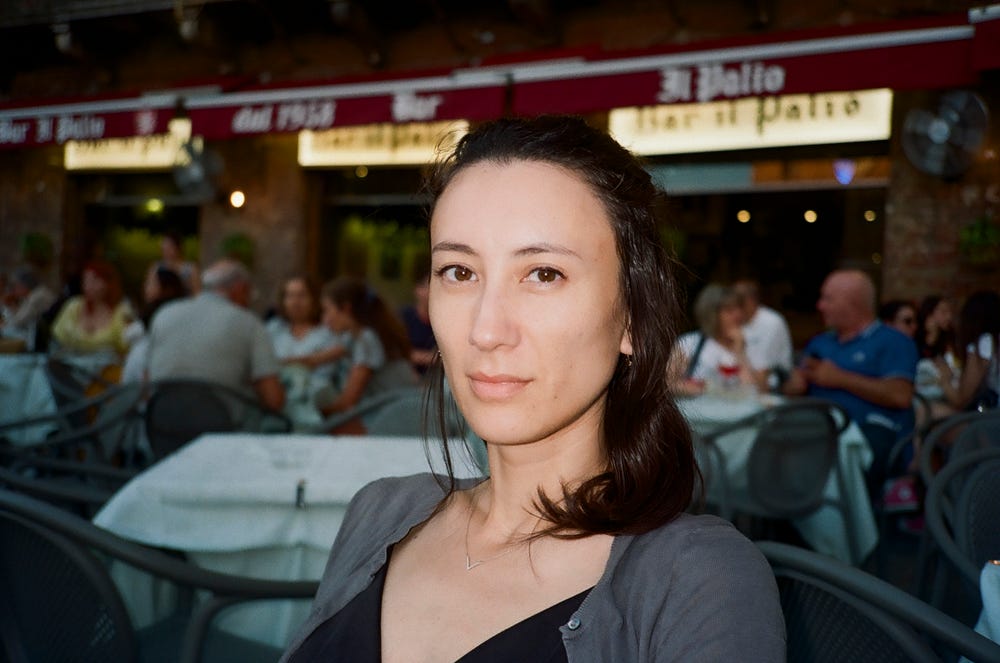
‘In the absence of a narrative,’ the Berlin journalist Hilda Hoy writes of learning to speak, ‘this is what I want to believe: My first word was “mama.” 媽媽, māmā, Mama. I want it to be true that from the first time I spoke, I voiced myself in English and Chinese both.’ The child of a Taiwanese mother and Canadian father, Hoy spent most of her early life in Taiwan, where her appearance marked her out as an a-tok-á—a foreigner—with English gradually becoming her dominant language over Mandarin. ‘When I speak Mandarin with my mother, I am reminded as always of the distance that separates us—my foreignness from the person who made me.’ When her mother was diagnosed with dementia, gradually losing the ability to speak, Hoy began probing the repercussions of her own language loss. In Mother Tongue, released last month by the Taiwan-based publisher Wind&Bones, Hoy sketches out her encounters with Mandarin lessons and Taiwanese game shows, as well as the painful intimacies of love and aging parents. We met up with her to discuss multilingualism, writing, and the disorientations of dislocation.
Hilda will be holding a book launch for Mother Tongue on May 13 at Ivallan’s Books (Schönleinstr. 32). Doors open at 19.30, event starts at 20.00. Entry is free.
What we’re eating: oolong tea and Laugenbrezel (HH), white tea and Möhrenschnitte (MM)
In your opening author’s note, you say that you first became a journalist so you could write without revealing yourself. What do you mean by that?
When I went to journalism school, we were specifically taught that your opinions should not be in the final piece—whether it’s TV, print, radio, whatever. As a journalist, you’re the medium through which the story comes, but you don’t put in your opinions and judgments and so on. I definitely internalized that for a long time—and, after all, it’s safer to not put yourself up for judgment. But I don’t want to write like that anymore. That kind of writing serves a certain purpose, but at the moment I’m most interested in telling the stories that only I can tell. It’s unavoidable to put my perspective, my curiosities, my opinions, my judgments, and so on in my work.
There is still that voice in me, the sort of shaming of the personal essay, of autofiction. You know, the ‘keep it in your diary, take it up with your therapist’ kind of judgment that women writers can get when they reveal their emotional landscape in their work. I try not to think about that too much because I think it’s just self-limiting. I’m still pretty private and pretty cautious about what I reveal and what I don’t, but this is definitely the most personal thing I’ve ever written, much less published.
How does it feel to bring yourself fully into the frame?
It does feel vulnerable. But at this point in my life, I’m ready to do that. Ten years ago, I wouldn’t have been. Probably even five years ago, I wouldn’t have been. But now I feel resilient enough to deal with it. I’m also writing about an experience that is very true to me—and I can feel the trueness of it. I’m not going to go out there and read my reviews on Amazon or Goodreads or whatever. But I do feel like, hey, the truth of my experience is here. And if other people don’t identify with it, that’s okay.
How different did it feel to write this, versus your earlier work, in journalism and in fiction?
I want to say it felt quite different. With fiction, I was always second-guessing myself, because you’re creating a story out of thin air. The possibilities with fiction are utterly infinite. Whereas with non-fiction, the truth of my experience defined the framework. There’s still a lot of self-editing that goes on; I don’t want to just have verbal diarrhea on the page. But my experience of writing Mother Tongue was… I don’t want to say easier, because it was definitely emotionally not easy. But of all the things I’ve ever written, this work is probably one where as long as I got out of my own way—as long as I silenced my own judgment and self-censorship—the writing actually just came out.
Honestly, I think what drove this work is that I really just wanted to be seen. I have met many mixed-race people in my life, but it’s very rare that I meet any who grew up in the place of their non-white parent. I’ve spent a lot of time in Canada, and of course, you meet many half-white, half-Asian people there. But their experiences don’t really resonate with me. I’ve read memoirs and essays by half-Asian writers who write about things like being bullied, being ostracized. But they are always framed by the experience of a white-dominant culture. I have what I consider two mother tongues, two native languages. But one is imperfect, my Mandarin is imperfect, which I feel in me as a lack, a loss. That’s something I’m always searching for in other writing, and I rarely find it.
I just felt like: well, I exist. Surely there are other people like me out there. I want to connect with them. And I want my experience to be seen. Not just by readers in the West, but also people in Taiwan. I want them to recognize that my experience is a valid experience.
My experience was not of a white-dominant society rejecting me for being other. My experience was of a Taiwanese society rejecting me for being other, or othering me, or distancing me as a foreigner. I’ve had to do a lot of work as an adult to work through that experience, and to claim a Taiwanese identity for myself. To remind myself that I have the right to do that. I would have loved to read something like that 10–15 years ago, when I was just beginning to untangle my experience of how I grew up.
Was there any writing that did feel like a jumping off point to tell the story you wanted to tell?
I don’t want to write a traditional memoir. I want to make wider connections beyond myself. Mother Tongue is an offshoot of a larger collection I’m working on about language and identity. I’m interested in people like me, who feel pulled to reclaim a relationship with a lost language, with their family’s heritage language. I’m really interested in multilingualism. I think Germany is in the midst of a really interesting transformation, having just changed the law to allow multiple citizenships about a year and a half ago. I think that signals the beginning of a process of recognizing that pluralistic identity is a fully normal thing. You don’t have to choose one or the other. You can be both.
But to answer your question about inspiration, I’m really drawn to the writing of Jhumpa Lahiri. Her fiction is great, yes, but I really love what she’s written about her experience with languages. She has a collection called In Other Words about learning Italian and writing in Italian, which she actually wrote fully in Italian and then had translated into English. She writes that she felt exiled from language for a lot of her life. Exiled from English, exiled from Bengali, her parents’ native language. But Italian was choosing her own path—she’s choosing a whole new medium in which to express herself, and experimenting with that.
There’s also a Japanese writer called Yoko Tawada, who has lived in Germany for many years and writes sometimes in German, sometimes in Japanese. I find her approach really liberating. She’s so free with writing in German, in a way I never gave myself permission to be, because I have this writerly idea that anything you write must be as perfect as possible. But it is a choice, not a fact, to believe that good writing is perfect writing.
After reading both of them, I’ve realized I’m probably going to have to write at least one of the essays in my [forthcoming] collection in German. I’m curious about giving myself the limitations of writing in German, and seeing how that limitation forces me to find new ways of expressing things.
That’s rather unusual for an English-language writer in Berlin: most of us barely learn German, let alone consider writing in it. Why did you feel like you also wanted to master German?
I just really like languages. I find languages in general fascinating. I can credit my upbringing to that, growing up with two languages. But I also have to give my dad credit. He was the white Canadian guy, and he was the one who insisted that growing up bilingual was really important. He would say to us again and again when we were kids: ‘To have a second language is to have a second soul.’ We’d always roll our eyes. He’s really fascinated by languages; he went to Taiwan to study Mandarin and that’s how he met my mom. I absorbed that from him.
I’ve studied languages before: I studied French in high school, I lived in Prague for a year and a half and studied Czech there. So when I came here, I was just like, of course I’m going to learn German. Why wouldn’t I? It’s a bonus: I’m living here and I get to study German. I feed my brain by learning German.
How do you think of these three languages—German, English, Mandarin—differently? Do they occupy different emotional terrain? Do they occupy different intellectual terrain?
The short answer is yes. They do occupy different places in my brain, in my psyche, in my emotional understanding of the world. English is my intellectual language: it’s the language I went to school in, that I started to publish in.
Mandarin is a very emotional language, because when I speak it, I am immediately very young again. It’s the language I spoke at home with my mom, with my family, in everyday, very quotidian settings. And also because my Mandarin is kind of childlike, so when I speak it, I probably act a bit younger or less assured and more goofy.
I find German to be a very structurally rigid language. I feel like writing well in German is a feat of engineering. I can’t say that I, as a writer, personally identify with those feats, but I respect them. I would like to find a way to express myself in German that pushes back, maybe, against the structural rigidness. I’m not sure how German readers would feel about that, whether they would be really annoyed. I think my strategy, when I try to write that essay in German, will be to write shorter sentences. Because I find the nesting, Nebensatz, Nebensatz, Nebensatz structure really… I don’t enjoy writing like that, and I don’t enjoy reading those sentences. I feel like the brain is always kind of going through contortions to try to keep track of everything. That’s not fun to me.
I’m also learning Italian, so my brain is kind of influenced by that as well. It’s a bit of a mindfuck, to be honest. But I really enjoy the chorus of languages in my head as well.
That chorus comes into the book in the way that each of your sections begins with a word: for instance, mā (mother), mùbiāo (goal), a-tok-á (a slang term for ‘foreigner’ in Taiwanese Hokkien). How did you end up with that structure?
I knew Mother Tongue would be made up of interlinked chapters or short segments. The original structure was based around the Mandarin classes I’ve been taking for the past year, through a local Taiwanese organization. Each section was going to be based around a particular lesson. Then last fall, I got my hands on a collection by a Dutch-Canadian poet, Sadiqa de Meijer. She has a collection that’s super great, called Alfabet/Alphabet—alphabet in Dutch and English. Her structure is based on the letters of the alphabet, going from A to Z. Each letter gets a quite short, poetic essay using that letter as a starting point. That inspired me.
I was also aware that I was writing for an audience that most likely wouldn’t know Mandarin. So I kind of wanted to teach a word here and there.
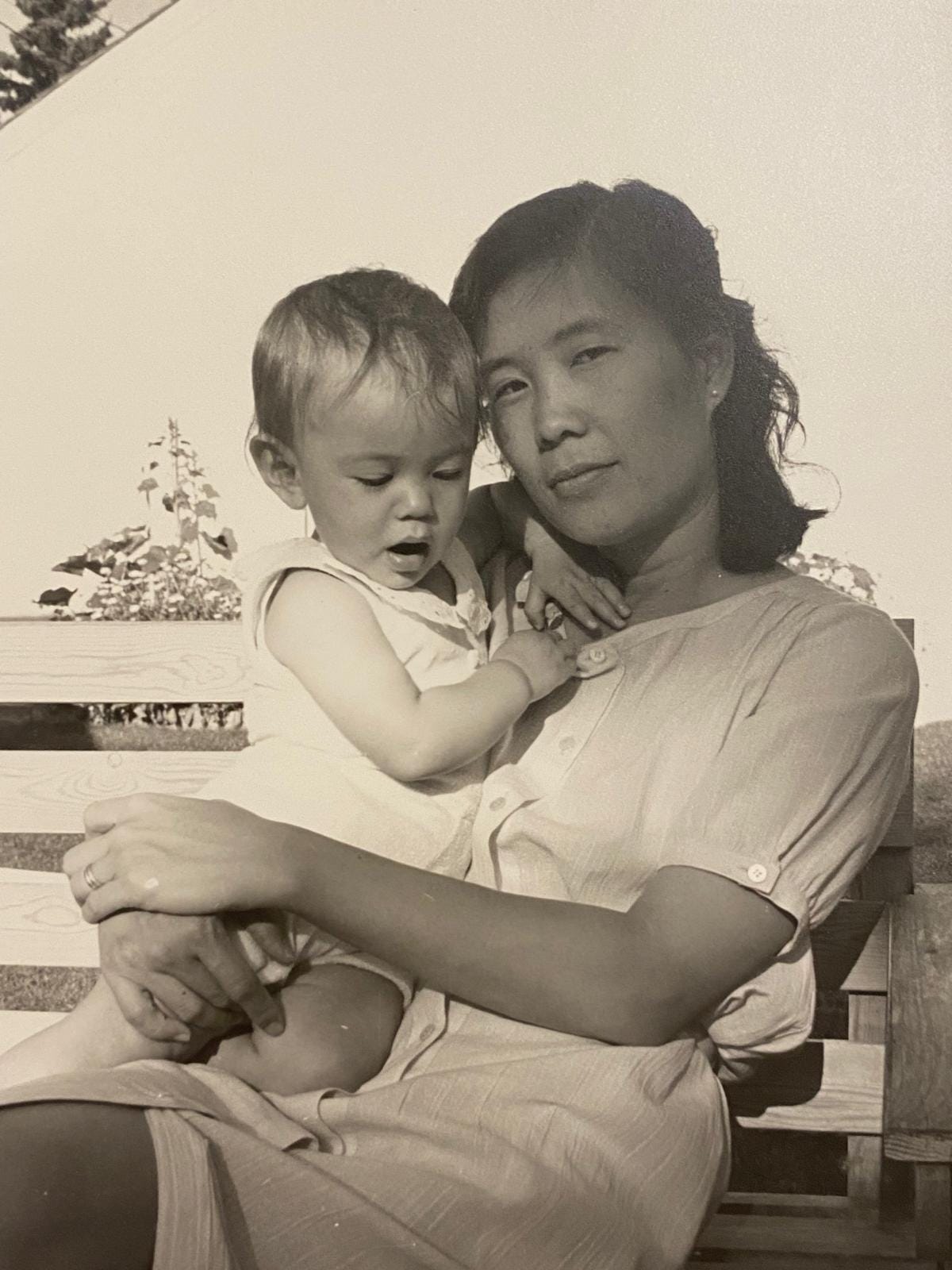
There are also photographs in the book. What was the impetus for including those?
That was the publisher’s idea, and I’m glad they suggested it. Much more than the writing, it was the photos that made me feel... Picking the photos felt fraught. I felt really conflicted. I knew they would enhance the work, so it’s not that I didn’t want to do it, but I just felt the most afraid of, I don’t know, showing too much. My mom is also at the point now in her dementia where she could no longer give consent to her photo being used. So I do feel like I’ve taken a liberty in showing her face. If she were still mentally with us, she would say yes, but I wasn’t able to actually ask her.
I’m still really glad the publishers made that suggestion, because when I get to the last page and I see my mom’s photo at the end, or at the beginning when it’s a photo of my mom and me as a baby… I don’t know, it feels right. But I don’t want to look at them too much.
You talked quite a bit in the book about the role of physical appearance in both connecting you to your parents and also differentiating you. Do you feel like the photographs, by putting faces to names, sort of enhance that? When you talk about your nose and your mom’s nose, the reader is then able to, well, look at them.
I think mixed-race people are so often subjected to this constant face judgment. Non-mixed-race people always give you this, like, ‘Oh, what are you?’ kind of scrutiny. You get this from childhood—at school, in professional settings, dating, all the time.
When my publisher made the suggestion of coming up with a selection of photos, I found one of my family, from when I was probably around five or six. The way we are positioned in the photo, you can see so clearly, like, child one, child two. Parent one, parent two. I’ve been told my whole life that my sister looks more Asian and I look more white. And so when I look at our family portrait, I think that automatically. I’m already making that judgment myself. I’m imagining what someone who doesn’t know me will be thinking, what assessment they’ll be making. What assessment someone who’s white will be making, what assessment someone who’s Asian will be making. All those calculations are happening.
I also felt like I needed to prove certain aspects of the narrative. When I say that I was treated like a white person, growing up in Taiwan, I felt like I needed the photograph to back me up. When I say I want to claim a Taiwanese identity for myself, it’s like showing my Taiwanese mother lends me legitimacy. That is an emotionally fraught thing. Because, on the one hand, what do I have to prove? But on the other hand, I know people will be curious to pick apart my face. Because that’s what they’ve done my whole life. So here you go. Here it is. Take a look.
You’ve touched a little bit on this, but do you feel like this childhood experience of multiculturalism—of being intentional about language, of knowing or realizing that language is a thing with borders—had any bearing on your decision to become a writer?
Maybe. The simple answer is that I do think things are probably interconnected. I think one of the main things that really fascinates me about language is that it is the primary means by which we express who we are, what we’re experiencing, our lives, our families, our loves, everything. So I think my curiosity about people is tied to my curiosity about how people express who they think they are.
That’s why I am interested in people with multilingual backgrounds like mine. What languages do they use to express which parts of themselves? When people have these very hybrid, many-faceted selves, part of that is many different languages connected to many different things, different parts of their family, different parts of their lives, their pasts, etc. It’s so rich. So it’s probably part of why I became a writer, but not consciously.
Are there certain contradictions—the dislocations of being racialized, of not having a unitary background—that being a writer allows you to work through?
I think being involved in any kind of creative work involves a deep level of reflection—I mean, ideally. Not everyone doing creative work is interested in self-reflection. I certainly am. What I can say is that it was in the process of writing Mother Tongue that I recognized that my family’s patchwork language is perhaps incomplete or perhaps imperfect, but it’s ours. It works for us. It’s always worked for us. And my use of Mandarin and how I can express myself in Mandarin and who I am in Mandarin is also incomplete, but also in its own way whole.
Mother Tongue is stocked at Chapters (Wilsnacker Str. 60), Curious Fox (Lausitzer Platz 17), Encounters Bookspace (Prinzenallee 60), Found in Wedding (Martin-Opitz-Str. 21), and St. George’s (Wörther Str. 27).