

February Books: Maci, Reimann, Clark
Essays from Enis Maci, a novella by the GDR's Brigitte Reimann, and Christopher Clark's nineteenth-century Prussia.


On the first Tuesday of each month, we’ll be publishing short reviews of books that we have noticed from our perch in Berlin and think you might find interesting. (Opinions are those of the reviewer, not The Auflauf.) There’s also some literary gossip down below. Later in the month, you can expect a feature interview and an extra scoop of content.
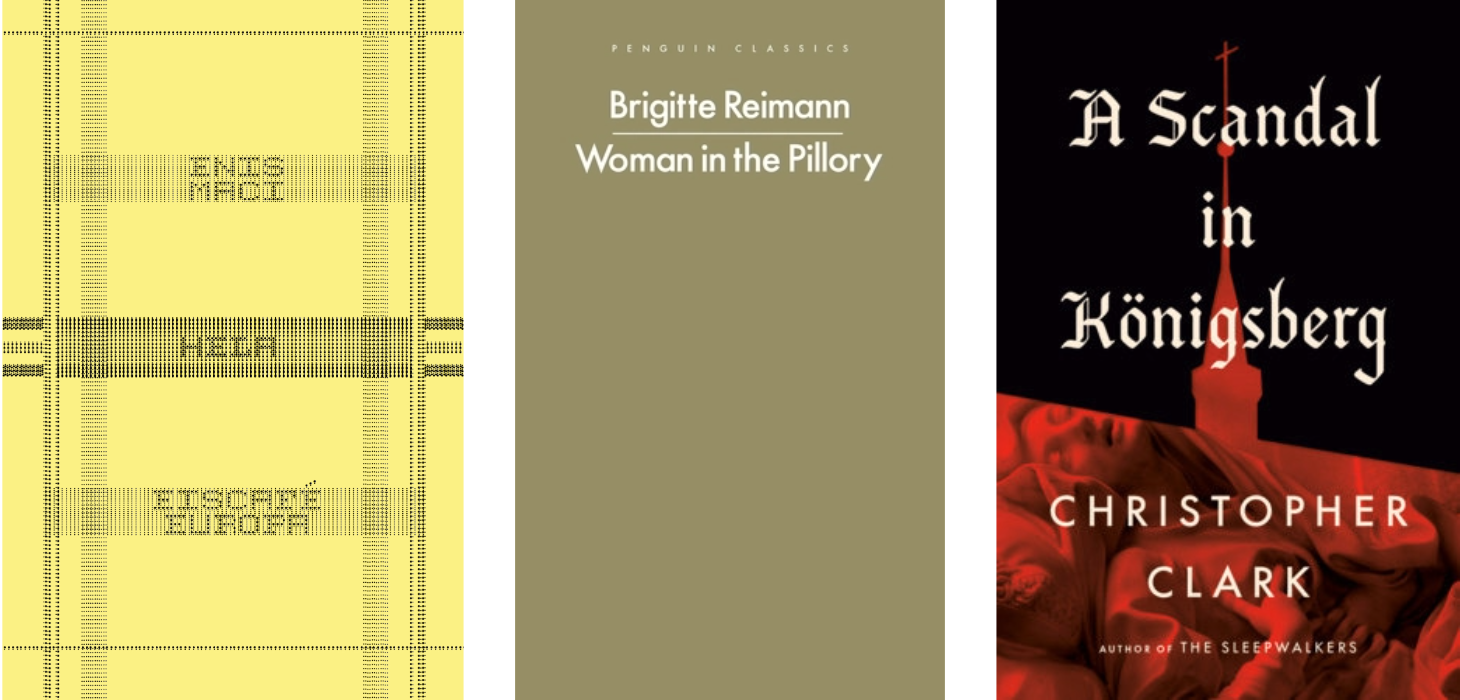
Eiscafé Europa (Hela Press)
Enis Maci, trans. Damien Laing
When Eiscafé Europa came out in Germany in 2018, it was a rare object of critical consensus, garnering praise across the political spectrum. Playing with confession and collage, and coupling critical investigation with theatrical gesture, Enis Maci’s debut essay collection offered German readers not simply analysis of the internet-riddled contemporary, but engagement with its texture—a compelling representation of the environment where the writer had grown up and which the alt-right had learned to cultivate for its own power. Now, with the book finally available in English thanks to Damien Laing’s fine translation, one could almost think of it as a relic. For, as Maci herself acknowledges in the translation’s added postscript, ‘much of what’s described here had already disappeared by the time this book was published’. And Anglophone readers might not find anything formally here that they haven’t already encountered in the growing corpus of Internet literature, from Tao Lin through Patricia Lockwood. Still, one perceives an undeniably alive and unique intelligence attempting to trace the constellations and contradictions that still haunt our present.
If the book does not quite achieve Maci’s declared desire for novelty—to develop a literary equivalent of the theremin, that strange musical instrument of pure vibes—its essays do deftly capture the vertiginous, paradoxical diversity of a rising online fascist culture made up of (u.a.) makeup tutorials, hashtags, asylum seeker beatings, Tumblr, Bhagavad Gita citations, and CasaPound. In these seven highly associative roving essays, the voices of relatives, rappers, childhood friends, and writers swim together; metaphor turns unstable as Maci slips across lived experience, family history, translations and mistranslations, emails and search results, world literature and micro influencers as she reckons with the strange becoming of herself and the nation of which she became a naturalized citizen. Within this collapse of registers, Maci’s style and form insists on particulars—not necessarily as the only things one can hold onto, but the only way to conjure, for an aesthetic moment, the evanescent vibes felt by those who were once there then. – SIB
Woman in the Pillory (Penguin Classics)
Brigitte Reimann, trans. Lucy Jones
This novella’s title gives away its end: Kathrin Marten, an overworked and underappreciated farmwife, is on her way to a public shaming. It is World War II; her crime is love. Love for Alexei, the Russian POW who works on her farm—and maybe also love for a new society just glinting over the horizon…
Reimann’s Siblings, from 1963, made a splash in English translation a few years ago for its portrayal of a woman stuck between love for her brother and commitment to an increasingly shabby state socialism. That disenchantment seems only more poignant in contrast to the starry-eyed, girl-meets-boy-meets-tractor idealism of this earlier work, published in 1956 when she was only 23. Reimann was never a state artist, but here is socialist realism at a propagandistic pitch, suffused with an almost painful ideological earnestness. Before they first make love, Alexei and Kathrin sit together and discuss the future. ‘You say you’ve started to do everything differently in Russia’, Kathrin says to him, enviously. ‘You’ve collectivized your land, and have started to create a new kind of person. But we’re in Germany.’ Wait: could socialism be possible in Germany? When the war ends, Kathrin’s village lies destroyed. The last line of the novel: ‘We’ll have to start all over again.’ Auferstanden aus Ruinen!
Still, the novella’s sincerity is winning. Reimann conveys genuine horror at fascism’s justifications for violence on the battlefield and at home, without ever abandoning the possibility of redemption. I wouldn’t necessarily have expected Penguin Classics to be in the business of publishing GDR propaganda—but then why not? All that mid-century Iowa Writers’ Workshop stuff is still on the shelves. – MM
A Scandal in Königsberg (Penguin Press)
Christopher Clark
In 1835, two Lutheran ministers in the sleepy city of Königsberg found themselves at the center of a salacious headline-grabbing scandal: the two were accused of leading a sexually deviant and subversive sect inspired by the theosophical teachings of an eccentric poet-preacher. According to shocking accounts from embittered former members, their cult included strange sexual initiation rituals and free love—and had even caused two young women to die from ‘excessive sexual arousal’.
This minor historical episode is taken up by star Cambridge historian Christopher Clark, who packs a lot into a slim book of some 150 pages. Clark deftly paints a picture of provincial Königsberg (now Russian Kaliningrad) and the intersecting upheavals that set the stage for the scandal: Post-Napoleonic ferment, consolidating Prussian state power, shifting gender politics, Kantian rationalism versus religious revival. Strange theological currents also play a role—like the influence of Johann Heinrich Schönherr, whose pseudoscientific inquiries supposedly showed that God created the world from two giant primordial eggs, one of light and the other water, that embodied the twinned energies of male and female.
Clark, best known for his authoritative works on far broader topics, stumbled upon the case while digging through Prussian archives in Berlin in the 1990s. As he explains in his foreword, he returns to it now because the story—of a purportedly impartial, progressive and liberal state apparatus latching onto ludicrous allegations—seems freshly relevant in our era of fake news and deranged politics. This angle has been picked up by more excitable reviewers, with the FT honking that the book ‘has as much to say about our own time as it does about 1830s Königsberg’.
Beyond some broad thematic resonances, however, there is a limit to the contemporary insight gleanable from an obscure church scandal from nearly two centuries ago in a place that no longer exists. The author himself is too diligent an historian to push the parallels too far, and as microhistories go, A Scandal in Königsberg is brilliantly done: a short and lively volume that uses a single obscure event to tug at the many animating threads of Prussian society. Just don’t go seeking the key to MAGA here. – Bryn Stole
Hot Sauce
Sources in Poland are telling us a famous autofictioneer has been caught in an embarrassing on-tour vape explosion debacle … Schadenfreude much? The giveaway is in the text, of course.
Meanwhile, rumours of adultery continue to follow a certain well-known London Kleist scholar. We all knew the Colonel was keen as mustard—but with a candlestick, really? And in the library?
One last morsel comes express from Brussels. Look: it’s one thing to plagiarize a personal essay. But an amorous sonnet must be all your own work. No wonder this poet is well known for waffle—well-sauced, perhaps, but still waffle. – Aubergine Fritz
Got some more sauce for us? Shoot Aubergine a tip at theauflauf@substack.com.
Really solid work juxtaposing Reimann's youthful idealism with her later disillusionment. That arc from 1956's earnest propaganda to 1963's more conflicted sibling loyalty captures something real about howmany socialist writers actually lived that history. I remember reading Siblings and being surprised at how nuanced the internal conflict was given the context. Makes me want to revisit her entire ouevre with this frame in mind.