Dženana Vucic: 'History happens to all of us'
The Bosnian-Australian author talks about war, memory, and what poems can do differently.

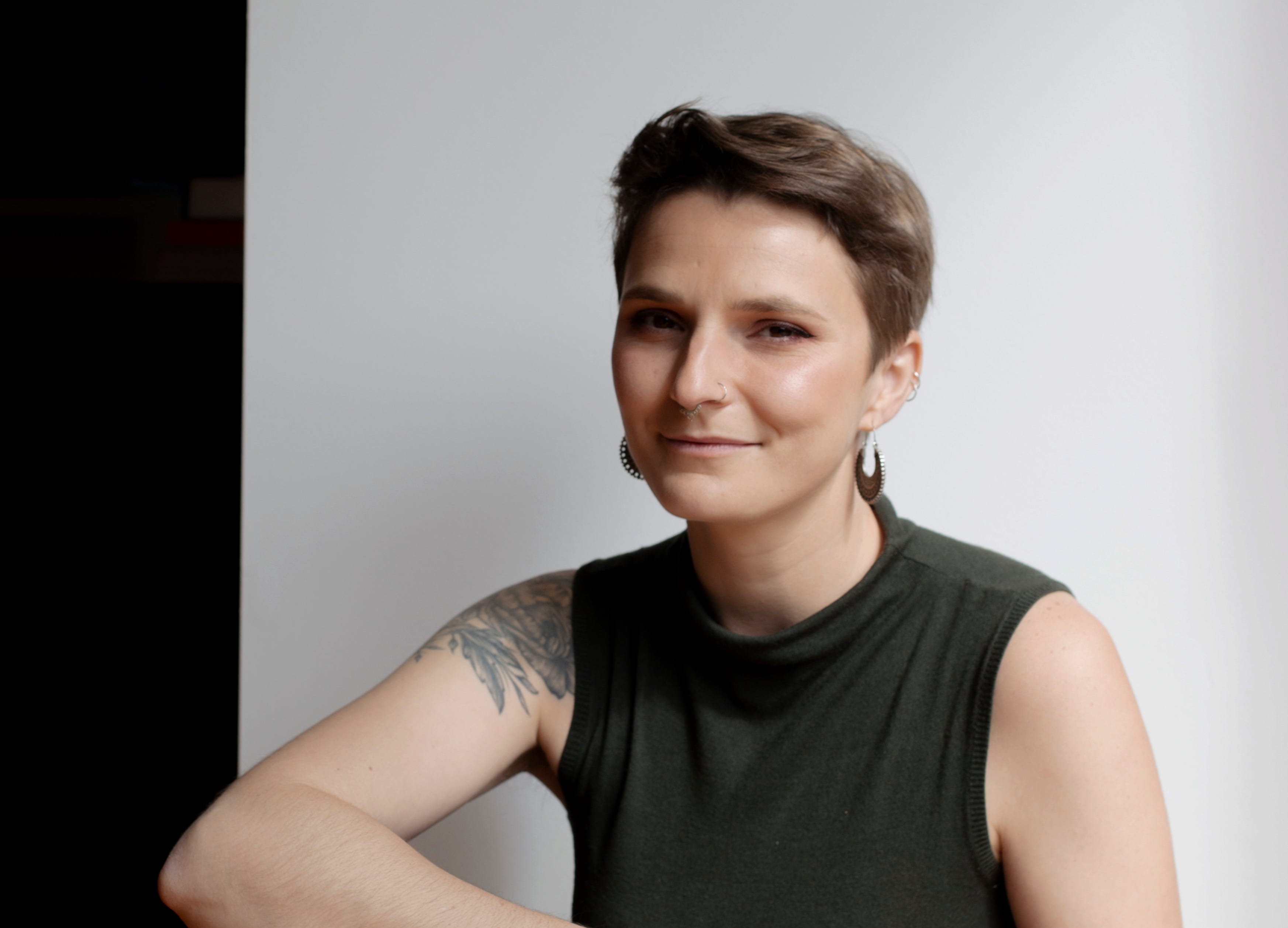
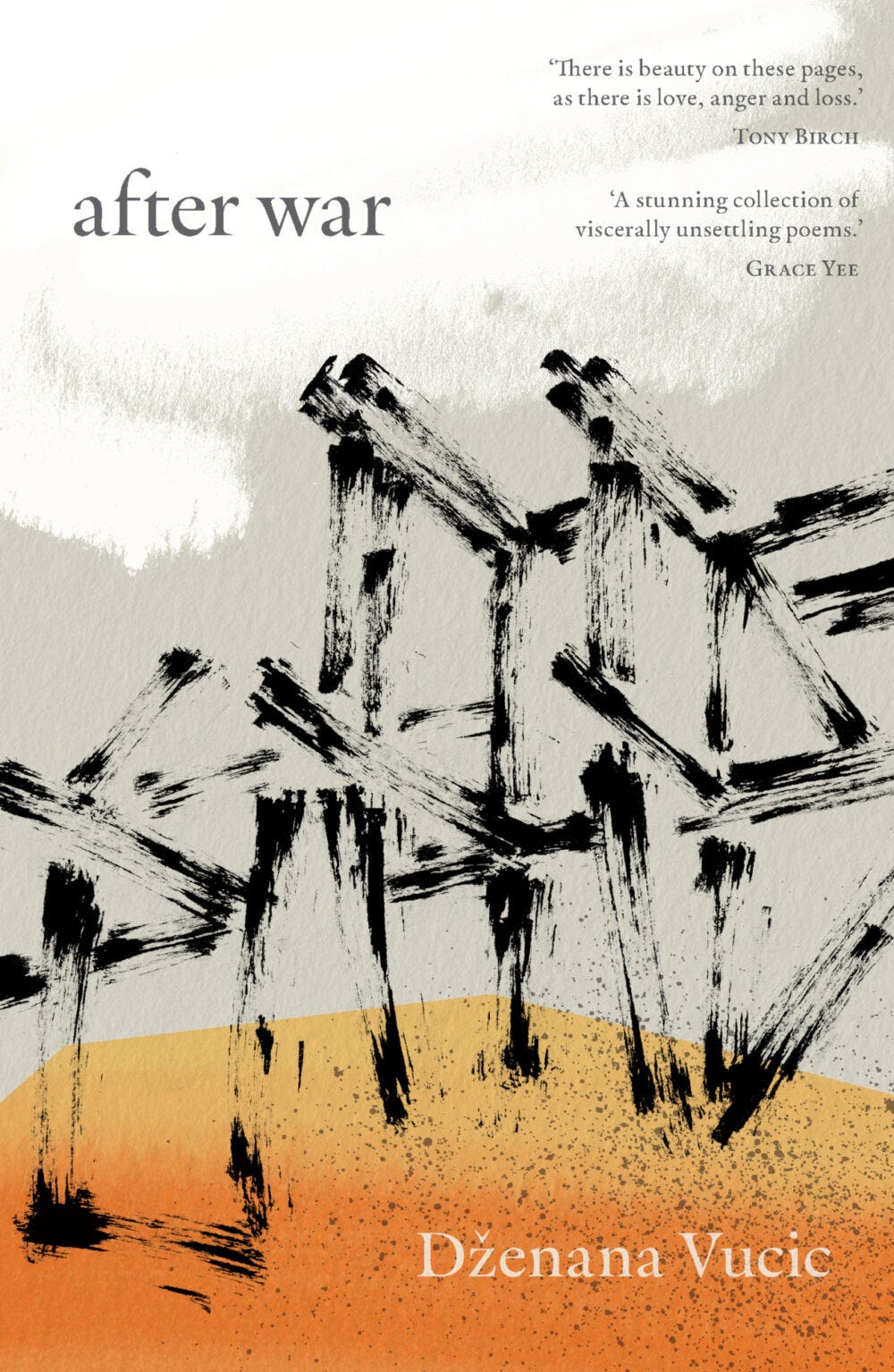
The debut book of Dženana Vucic—acclaimed Bosnian-Australian author, critic, and editor—has an intriguing subtitle. This work, we are told, is a memoir in poetry, in pieces. It is an apt claim. The poems in after war are personal; they are rooted in the particularity of experience, specifically that of someone who fled the brutality and ethnic cleansing inflicted on Bosnians during the war of 1992–1995 then grew up in Australia, accompanied by sister and mother, before returning to Europe—Bosnia, Berlin—as an adult. (‘Years ago,’ says the speaker of a poem late on, ‘I tried to move home but found only foreign countries’.) The book is also made up of pieces: pieces of literature, sure, but also different kinds of poem, different kinds of voice, all of which reflect the long shattering aftermath of historical trauma. Poems like ‘First Year After War’ and ‘[trigger warning]’ directly address the difficulty of speaking in such conditions; others, like the long erasure poem about Srebrenica, hold catastrophe in their form. Yet the collection’s scope extends far beyond that of any traditional memoir. Constantly, and in many different ways, Vucic reaches out from personal experience into other disasters and other contexts, most prominently the atrocities inflicted by Israel in Gaza. I met up with Vucic in a Neukölln café to discuss her book just after she returned from a multi-city reading tour Down Under. Somehow, she had not forgotten to bring me back a thing of Iced VoVo biscuits.
The Berlin launch of after war will take place at Lettrétage (Veteranenstr. 21) on July 30 at 7:30pm. More information here.
What we’re having: flat white (DV), flat white (AW).
Dženana, congratulations on this astonishing book. It is out on an Australian press. Will people be able to buy it in Berlin?
Yes, yes, that’s why I couldn’t bring you more Iced Vovos—because I was lugging seven kilos worth of my book in my suitcase. (laughs) It’ll be available at the launch.
How long were you working on the poems in the collection?
I think it was six, maybe seven years. I had actually been working on another book that I kept stalling on. It was supposed to be a memoir about the Bosnian War, about my family’s move to Australia, about myth and history and memory-making and how we tell the story of ourselves. But I found it impossible to write, somehow. All the family stories—all the conflicting stories—and the pain and hurt that attended them… Narrative memoir just wasn’t working for me. I turned to poetry. And when I started conceiving of this as a collection, back in 2021, Israel was bombing Gaza and evicting families from Sheikh Jarrah, and I just felt compelled to do something that also spoke to violences that were happening contemporaneously. Poetry felt more capacious. It offered a way of speaking through us into we, of taking the specifics of our story and threading them into a broader web of specifics and stories in a way I couldn’t quite reach with straight memoir.
The poems in this collection really vary in form—in voice, too, and perspective. Is that part of what poetry could offer? A certain shapeshiftingness of the ‘I’?
Memoir was locking me too much into the specifics of our escape from Bosnia—which is very complicated, very narratively interesting, with a lot of twists and turns. But it kept getting in the way of what I really wanted to talk about, which was the ongoingness of violence. I wanted to talk about our complicity in it, about how we are implicated in systems of oppression and intolerance. And I felt that looking too much at myself or at my family wouldn’t allow that to happen. As you say, the ‘I’ of poetry is more shifting, more expansive, it can be many people, many things—innocent on one line, culpable the next. Poetry definitely allowed me to play with form to achieve specific ends in a way that memoir couldn’t… That was really appealing to me, because I could say things without saying them explicitly—I could say them in the shape or structure of the poem.
It felt to me that these poems—like many poems, or all poems, depending how you read—are concerned with the nature of speech itself. The speaker might start then break off, or might circle a traumatic event, or might try to explain but not get listened to. Did you want to not just talk about the war, but talk about talking about the war?
I think so. One of the things that interests me most is who gets listened to, and when. Part of this has to do with the realities of the Bosnian war, where the Bosnian Muslims were saying it was a genocide but everyone else was calling it ‘ethnic cleansing’—the term was popularised in that war!—and we were asking for international help, or at the very least to be allowed to defend ourselves. But the ‘international community’ wasn’t listening and before they started to, the UN allowed a massacre of over 8,300 men and boys because they believed the other side, despite all evidence to the contrary. Obviously this isn’t exceptional. It’s happening all the time. So yeah. I think questions around who gets to speak, who is listened to, whose stories are considered compelling are vital ones for us to be asking.
I think of the poem ‘[trigger warning]’, which is about people turning away from survivors and their stories. It ends: I said look at us when we’re talking to you. There are other moments, too, when one feels a bit of tension between the I and the you. Is that tension a device? Is it something you feel personally?
It’s definitely something I feel personally. I think I have a strong sense of justice. Which is not to say I’m an ethical actor in all circumstances—God knows it’s impossible to be that in this world—but I feel very strongly about trying to be, and it’s something that really enlivens my writerly instincts: injustice, how we are implicated or complicit in various harms, what it means when people are silent on something they should be vocal about, or when people opt to turn away from something they should be looking at. I mean, we live in Germany, so we’ve got a very clear example of that happening with respect to Palestine. With ‘[trigger warning]’ I was trying to think through some complicated feelings I’ve been having about them lately. Increasingly, I wonder if they’re protecting who they’re meant to protect—or if they’re providing a means for others to turn away from things they don’t want to see in the name of ‘self-care’. It strikes me that it’s actually really important to be confronted by something you’re uncomfortable with, something that makes you feel uneasy or shitty, if it would help you better understand the circumstances of someone with a lived experience of it.
You’ve written brilliantly about (re)learning the Bosnian language as an adult. And Bosnian appears throughout this collection—sometimes as fragments of speech, sometimes in poems that are explicitly about learning the language. For me, as a non-speaker, it produced an interesting alienation effect: sometimes I’d look up what certain lines meant. Did you feel close to the language while writing, or was there also an estrangement on your end?
I felt very close to it, which is kind of weird since my Bosnian isn’t great. It’s passable—it’s the language I use to speak when I’m in the country—but it’s certainly not a language I can express complex ideas in. But most of these poems were written as I was re-learning the language, and all the Bosnian in them is stuff I had recently picked up—albeit, admittedly, with some grammatical mistakes. many of which my mother helped me fix. I ended up keeping some of the errors because that felt real to the fact that I don’t speak perfect Bosnian, so it would be absurd if I did in the book. I suppose the mistakes that remain are a way of indicating a degree of my distance from the language, though like I said, I didn’t feel estranged from it at all while writing. Actually, there was a question, during editing, about whether I would provide translations, and whether we would use italics for the Bosnian. We pretty quickly decided on no translations and what probably looks like a very inconsistent approach to italics. But there’s a consistency in my mind. It’s about my familiarity in the moment of the poem. For example, in ‘First Year After War’, the English dialogue is italicised, whereas the Bosnian is left unitalicised, because at that time I was able to speak Bosnian fluently but not English. So the estrangement went the other way there.
I tried to come up with a brilliant question that would justify quoting this part of the poem ‘To Learn a M/other Tongue’: Grammar proves stubborn, / forcing us into the perpetual present. There’s always someone / missing and we can never be sure who did what to whom since / I conjugate poorly and without / regard to grammatical gender. But I think I just wanted to draw attention to how witty and clever it is. Or is there something profound there about the brokenness of language and the brokenness of history?
(laughs) Thank you, firstly, because I thought that was a great joke, but people don’t seem to appreciate it. Or they feel like they aren’t supposed to be amused. So thank you. After my launch in Naarm/Melbourne, one of my friends said he thought the collection was quite funny and everyone at the table gave him a look, like, what are you talking about. But there’s some bangers in there, right? (laughs) But anyway. Language. Yes. I think there’s something to that. I don’t believe that language shapes how we think about history in some sort of Sapir-Whorf type way—but I do think it can offer orientation, it can shine a light on different aspects of a thing. For instance, I’m interested in the lack of the dative case in English. In Bosnian you always say who is doing the action to whom. It’s integral—it’s even there in the way you say someone’s name. When I speak my imperfect Bosnian, it can be very confusing for people when I just say their names in the regular form because it’s grammatically unclear who is doing the giving, say, or doing the aggressing. Which is a fruitful place to linger in the context of the Bosnian War.
At the book’s centre is a long erasure poem about Srebrenica, where you have taken a prosecutor’s report on the case against war criminal Radovan Karadžić and removed most of the text, leaving behind a new poem in the remnants. Like all good erasure poems, it’s an impressive act of virtuosoism. But the method of erasing also seemed to have a deeper motivation in this context.
Yes, I wanted to foreground the idea of erased history—of stories not told. The erasure poetry I’m most inspired by is works like Zong! by M. NourbeSe Philip, which is a book-length erasure of a legal case report. The case had to do with an insurance claim that British slavers were making over enslaved people that they had thrown overboard because it was more profitable for them to make an insurance claim than to sell the people. I think where erasure is most powerful is when you’re telling stories like these, suppressed histories. I chose to do it for this text because I was really interested in how much time there was between when it became evident that something terrible was going on and when it actually started to happen. So the erasure is actually of all the events, as laid out in the judgment, that occurred prior to the day that the genocide in Srebrenica started. Famously the Dutchbat [Dutch UN peacekeeping] soldiers just stood aside and let it happen, but what I wanted to get at is that the whole international community did the same, just watching the war play out on TV. I wanted to emphasise just how much time there was to intervene, and having this long block of pages in the middle of the book got towards that. The erasure element was also important in that it reflects how this history is being actively suppressed and erased, both within Bosnia (to say nothing of Serbia) and around the world. In Srebrenica, mass graves were dug up and the bodies in them reburied elsewhere in an overt attempt to hide the genocide. These days, the different ethnicities in Bosnia learn different histories from different textbooks, and many kids aren’t taught about the genocide at all—or else they’re told a skewed version of it. There’s a lot of genocide denial in the country and also on the international level—I mean, there’s a very convincing line of critique suggesting that the courts were hesitant to call a genocide a genocide for fear that it would have ramifications for other ‘conflicts’ around the world. So erasure felt reflective of what has been happening in that sense.
Erasure also seemed to change the sense of scale, somehow, or to drive towards abstraction.
Yeah, exactly. Here, for example, I decided to remove all instances of the perpetrator, all of their specifics, from the text in order to speak to broader patterns. Like right now, we only have to look to what’s happening to the Uyghur people, to the Rohingya. What’s happening in Sudan and Kashmir and Palestine and Iran. And I was motivated by the fact that a lot of the violence being committed around the world is being committed against Muslims. We tend to ignore that fact while, at the same time, their being Muslim makes it easier for us to ignore what’s being done to them. After all, violence against Muslims has become something of a norm, one that’s been enabled partly by the USA’s propagation of the idea of the Muslim terrorist, which they didn’t invent, but by God have they done the devil’s own work in spreading. That’s why it felt really important to leave that specific word, Muslim, in—to gesture towards the violences being experienced by other Muslim communities.
One of the most striking things about the collection is its eagerness to draw lines of continuity or solidarity from the Bosnian experience to other experiences—and from the past into the present. Was that always how you wanted to write it?
Yes, yes, I mean, partly the continuity aspect is just because it’s still so much a part of life in Bosnia. In my village, across from me, there’s a bombed-out house. Two doors down is a memorial to the Croats—most of them our neighbours—that the Bosnian Army murdered in 1993. The war hasn’t gone away; it surrounds us, always, in Bosnia. But the other part is that people simply haven’t learned anything from any of the violence. We’ve learned to do it differently—it’s not trench warfare anymore, it’s drones—and we’ve learned to justify it in different ways. But, at the end of the day, we just keep doing this. And in the face of that, I don’t feel like I can write about anything else, honestly. I feel really compelled by the question of why, and how do we stop. Is it possible to be better? That question haunts everything I do.
That continuity, that multidirectionalness, that broader empathy—in the way you’re talking, it seems self-evident to write this way. But a lot of people tell very different kinds of stories about genocide and war, stories that are far less open to other sufferers but aim instead towards solipsism or vengeance. Why do you think your outlook is different?
I think history denies us personal experience because everything is felt communally. And I think I’m just not very interested in myself except in the way that I am in and of the world. I don’t feel you can just take a moment, a story, discretely out of everything that has come before. I mean, the Bosnian War existed in a history of colonisation and European expansion with the Ottomans, the Austro-Hungarians, the Germans, and all of this is part of the story of what led to the war—and it is inextricable from all that, just as the conflict is inextricable from the situation in Bosnia today, which is in turn inextricable from Europe, and the world and on and on. I don’t know. It’s all inextricable. You cannot simply draw a line around history. And I fundamentally don’t believe that it’s possible to tell a story that is only about what happened to us. History happens to all of us. Maybe that is why the memoir was failing.
Dženana’s book after war is published by University of Queensland Press and is available online at Foyles and Readings. It will also be for sale at her launch.