

April Books: Zaqtan, Mehr, Biedermann
New poetry from Ghassan Zaqtan, Mariella Mehr's short prose, and a novel by Nelio Biedermann—plus some informative verse


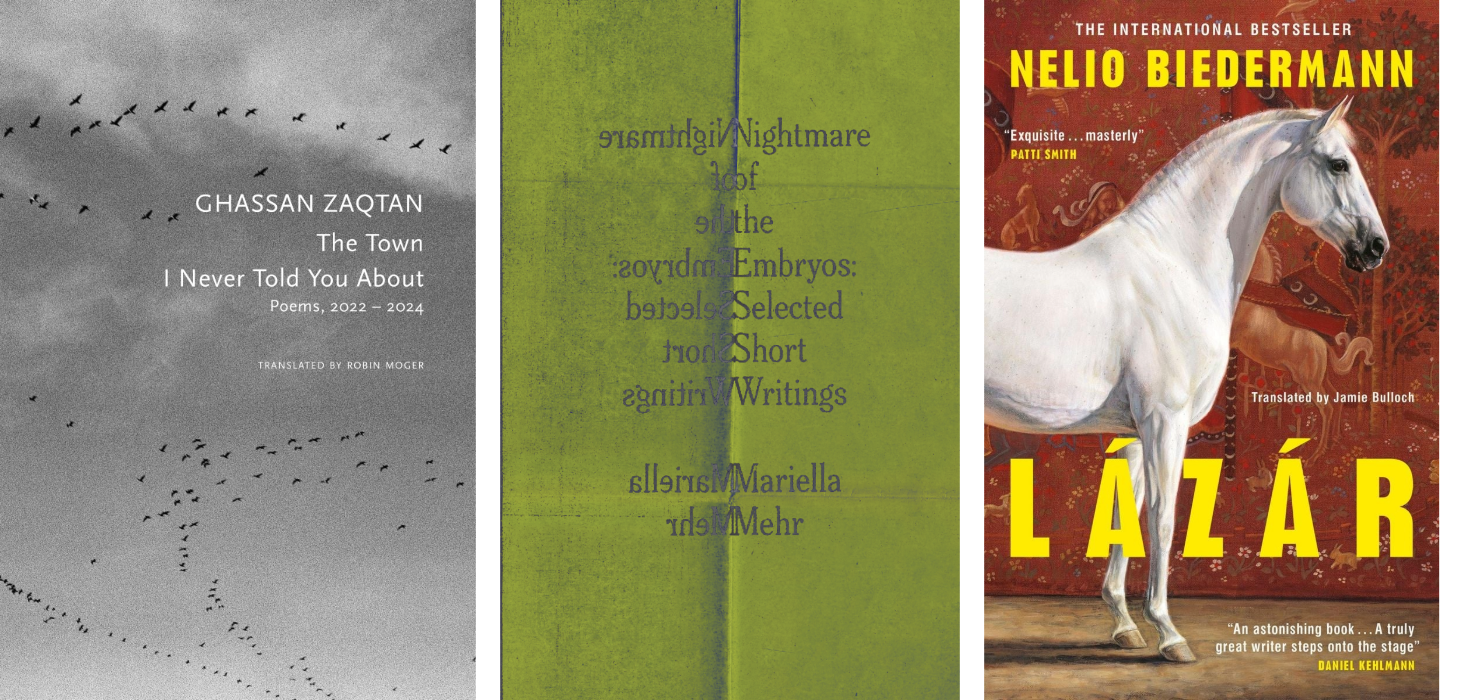
The Town I Never Told You About (Seagull Books)
Ghassan Zaqtan, trans. Robin Moger
Ghassan Zaqtan is one of Palestine’s most celebrated poets. Born in 1954 in Beit Jala, he moved between Jordan, Lebanon, Syria, and Tunisia before returning to the West Bank in 1994. This collection combines new poems written between 2022 and 2024 with earlier poems that Zaqtan has revised for the occasion. ‘In their second writing,’ he explains, they are ‘a world away from the sanctity of first versions.’ As Fady Joudah has written, Zaqtan has shifted in recent decades towards increasingly intimate, tactile lyrical registers. What makes this collection so astonishingly powerful is the way it shifts between, on the one hand, elements of a personal poetics and on the other hand, the constant intrusion of historical pain and political violence. Some of his poems are more explicitly engaged with the pain of exile, dispossession, and war. Others adopt a more existentialist note, as in the eeriness and yearning and ruptured cyclicality of this short poem:
In the night, strange trees came to the hill
and the muffled cypress climbed up from the valley.
Ghosts of abandoned houses could be seen,
    advancing through the mist,
and ancient human voices heard,
    calling to each other by name,
and there were clouds from the winter before.
Zaqtan’s speakers never lose their tenderness, nor their urge for connectivity; yet their links to the past, and to their fellow spirits, haves been broken. Memory itself becomes a victim of oppression. The disaster of a people—and the disaster of life—leaves each person, daily, lonesome. Names abandon their owners; the dead rise then fall. The Jordan River of his childhood, since dammed by Israel, runs dry. Zaqtan conjures shifting degrees of historical depth, like a ruined house where some corridors go and go and go while others suddenly shut, the family portrait rendered mute, or even falling apart in one’s hands; continuity is never a certain thing, here, and the effort of remembering seems vast. Yet remembering must be done. One later poem ends like this:
We carried our dear river on our shoulders
    and our precious lakes,
like one who lifts the miracles of creation
    from the prophets’ backs;
a miracle in every body of water,
a massacre in every land.
- AW
Nightmare of the Embryos (New Directions)
Mariella Mehr, trans. Caroline Froh
Mariella Mehr is one of these people—poets, mystics, the brilliant, the mad, call them what you will—who simply see the world differently than you or me. Or, at least, Caroline Froh’s excellent translation from the German of the Swiss author’s prose presents a world of associations and connections that continue to pulse with novelty. Be warned: it’s an intense world, a world of violation and horror, of abuse and injustice, and terrible acts committed against the most vulnerable. It’s also real poetry.
If you had lived her life, you too would see the world differently. But perhaps that is a disservice to her exceptional talent. Born in 1947, she spent most of her life until she was 20 institutionalized, targeted by the Swiss state for her Yenish heritage—a campaign the state admitted in 2025, three years after her death, was a crime against humanity. After surviving this forced abduction, the electroshock therapy that began at the age of 6, and so many other indignities, Mehr worked in a factory until, in her mid thirties, she convinced an editor she met by chance at a bar to read her debut piece: ‘Nightmare of the Embryos’. It gives this volume its name—and is a haunting story across sixteen years of abuse and rape at the ‘Highway Children’s Home’ where Mehr grew up.
Like Paul Celan, Mehr is a poet of suffering. ‘It is screaming again, albino-life in the process of dying’, begins one short piece. But Mehr does more than dramatize extraordinary suffering and violation. The pieces in this collection also reflect on Esther Altorfer and report on Holocaust remembrance in Berlin—always ingeniously integrating fancy and fantasy. And there are no screams in pieces like ‘Came down to the valley, leaving now’, which tells of the end of a relationship with stripped-down psychological precision. And yet, even there, Mehr’s final line leaves the reader in the surreal, if quotidian, moment of dusk, a time that might be emblematic of Mehr’s work overall: a moment where, despite the fading light, something new is also becoming if not visible, at least imaginable. ‘Dusk is her time, the time of night-shadow animals, of monks, of lion plants.’ - SIB
Sanders recently wrote about the present and future of Berlin Roma/Sinti Holocaust remembrance for Cabinet.
Lázár (Hachette UK)
Nelio Biedermann, trans. Jamie Bulloch
The back cover of Lázár, a new novel about an aristocratic Hungarian family in the first half of the 20th century, wants you to know that it is ‘inspired by the author’s own family story’. As a reader, that proclaimed angle feels increasingly bizarre—I’m sorry to be prudish—given how much time is spent describing its characters’ sexual encounters. That’s not necessarily a bad thing: the horny awakenings of various adolescents are a way to mark the passage of time. But there is a point when you realize author Nelio Biedermann is writing about his grandpa (or great-grandpa) jerking off that it all becomes a bit too Freudian.
The 23-year-old is German-language literature’s latest wunderkind-for-export, and although his precociousness is a great marketing tactic, it also offers less-than-impressed reviewers some low hanging fruit. (NDR has noted that Lázár has zu viel Schlaumeierei.) Despite or perhaps because of his age, Biedermann is keenly aware of the power of literary legacy: for instance, there are at least three Thomas Mann Easter eggs—four, if you count the entire premise of the novel.
Lázár begins with the birth of Lajos, a ‘translucent child’, in the family’s countryside manor at the ‘dying’ end of the 19th century, and moves impressionistically through the political and familial tumult of the next 50-odd years: ‘For Lajos, the end of the Monarchy was the only logical outcome; he had always regarded the physical and mental decay of his father as its embodiment.’ The narration flits between characters major and minor; in one especially odd moment, the perspective shifts to Stalin.
Ultimately, the novel reads like a lightly fictionalized amalgam of family legends, and Biedermann seems hampered by his episodic structure. We don’t spend enough time with any single character for emotional stakes to be realized or motives to be interrogated—or really even established. This effect is perhaps intended to tell a story of history happening to a family, its members making no decisions of their own. But more likely is that Biedermann is just too green and too close to his material to really analyze his characters. This becomes crystal clear when the Lázárs are faced with the reality of the Holocaust: as an adult, Lajos’ complicity in the ghettoization and deportation of Jews becomes little more than a vague sense of guilt. Biedermann goes no further; there is no actual reckoning with his relative’s role, and the lack of emotional depth here and elsewhere trivializes the horrors the family faces at the end of the war.
Biedermann’s family history undoubtedly contains elements one might call “novelistic,” but his version of them could have used a deeper treatment—and perhaps a few more drafts. - Nora Biette-Timmons
Hot Sauce
This month’s edition comes out of our Pan-European Gossip Correspondent’s recent residency at the Limerick Writers’ Centre.
A Berliner once drove to Hyères
and there she hooked up with an heir
But she wrote autofiction,
which created some friction:
soon there may be an end to the affair.
An expat got banned from the Stabi
(for flirting too much in the lobby).
“What’s a fellow to do?
Deutschland’s rules got me blue!”
Now he’s living it up in Abu Dhabi.
An Angelus’ stuff is still hot,
so we took a quick look at the lot
Re: mechanical reproduction,
he had some real gumption,
because all were the work of a bot!
– Marguerite McEnnedy
Got some more sauce for us? Shoot Marguerite a tip at theauflauf@substack.com.